Crash Casino Games in Australia: What to Expect in 2026
 Available in AU
Table of Contents
- Cash‑Based Crash Casinos: What’s Available and How They Operate
- Online Crash Casinos in Australia: Legal Landscape and Regulations
- Crash Casino Game Mechanics and What to Expect in 2026
- Crash Slots vs Traditional Slots: Key Differences
- Variety of Crash Games: From Classic to Innovative Variants
- Playing Crash Casino Games for Free: Benefits and Limitations
- Crypto‑Powered Crash Casinos: Opportunities and Risks
- Crash Casino Strategy, Rules, and Bankroll Management
- Bitcoin‑Backed and Balloon Crash Games: How They Work
- Provably Fair Play in Crash Casinos: How Transparency Is Ensured
Cash‑Based Crash Casinos: What’s Available and How They Operate
First time I heard "cash out before it crashes," I pictured something closer to a carnival game than a casino. That’s basically what it is. A multiplier climbs, you watch it, and you hit a button before the line collapses. Miss your window and whatever you staked is gone. Hit it right and you walk away with real money. Simple to explain, brutal to actually get right, especially at two in the morning when you’re convinced the next round is "due."
Here’s the thing nobody tells you upfront: when people search for a place to play these games with actual cash payouts, sitting inside Australia, they’re already looking in the wrong postcode. There’s no such thing as a domestically licensed operator running real-money crash games for Australians. Not one. I went looking for a long time, half-expecting to find some state-regulated corner I’d missed. There isn’t one. If a site is taking your money and promising a cash-out, it’s operating from somewhere else — Curaçao, Malta, wherever — not from an office in Sydney or Melbourne with an Australian gambling licence pinned to the wall.
Why "cash-based" doesn’t mean what you’d assume
When I say cash-based, I mean the mechanic: you deposit actual currency, place a real stake, and cash out for real money if you time it right. No demo credits, no play-money sandbox. That’s the whole appeal for a lot of players — the tension only exists because the money is real.
No domestic cash‑based crash casino is legal in Australia – operators must be offshore.
But "cash-based" doesn’t mean "based in Australia" or "licensed in Australia." Those are two completely different things, and mixing them up is how people end up disappointed. The Interactive Gambling Act 2001 (IGA) is the Commonwealth law that governs this space, and its entire point was harm minimisation — protecting the public from exactly the kind of unregulated, anything-goes gambling that crash games can become if nobody’s watching. Under that framework, online casino-style games — and that bracket stretches to cover slots, poker, blackjack, roulette, and by extension the crash-style games that behave like a slot with a multiplier bolted on — are prohibited federally. Worth flagging here too: some sources point to an earlier Interactive Gambling Act from 1997 as the one that actually bans offering these games to Australian residents, others cite the 2001 version. The dates disagree. What doesn’t disagree is the outcome — this category of game isn’t something an operator can legally offer from inside Australia, full stop, regardless of which act you cite.
So no domestic operator, no local licence, and — this is the part that trips people up — no legal pathway for one to exist. It’s not that nobody’s bothered to apply. It’s that the door isn’t open.
What’s actually available, then
If you’re in Australia and you want to play a crash game for real money, what’s "available" to you sits offshore. These platforms operate under licences from other jurisdictions and accept Australian players without being licensed to do so in Australia. That’s the practical reality, not a technicality — the operator sits outside the country, outside the IGA’s licensing reach, and outside any state regulator’s day-to-day oversight of how the game actually runs.
Offshore operators use their own supported methods; Australian rules limit which payment methods can be used for gambling.
Handled on the operator’s terms because no Australian regulator oversees the transaction.
Vary by operator rather than a single national standard.
That distinction matters for how these platforms operate day to day:
- Payment rails run through whatever the offshore operator supports — the constraint here isn’t a technical one, it’s regulatory, since Australian rules restrict what payment methods can be used for gambling in the first place.
- Dispute resolution happens on the operator’s terms, because there’s no Australian regulator sitting between you and them enforcing local consumer protections on that specific transaction.
- Age and identity checks vary by operator rather than by a single national standard, since there’s no domestic licensing body setting one baseline for all of them.
None of this makes offshore crash platforms illegal for you to use personally — the law here targets the operators offering the service, not the individual sitting on the couch pressing cash-out. But it does mean the safety net you’d expect from a "licensed local casino" simply isn’t underneath you. There’s no local regulator to call. There’s no domestic ombudsman for this specific product. You’re playing on someone else’s turf, under someone else’s rules.
The gap between "cash-based" and "locally regulated"
I want to be blunt about this because it’s the single most common confusion I ran into early on: a crash platform accepting real cash and paying out real cash is not the same thing as a regulated crash platform, and it’s definitely not the same as a domestic one. You can have all three. You can also have none of them beyond the first.

Australian law draws a clean line — online casino games, poker, and in-play betting are all prohibited at the federal level, no exceptions carved out for crash-style multiplier games just because they look more like an arcade toy than a roulette wheel. The mechanics might feel novel — climbing number, cash-out button, crash animation — but legally it sits in the same prohibited bracket as pokies and blackjack. A different skin on the same category.
What that means practically: any site letting Australians cash in and cash out with real money is doing so from outside the system the IGA built, not from inside a gap in it. There isn’t a "compliant" cash-based crash casino sitting quietly in Brisbane that just hasn’t been discovered yet. It doesn’t exist because it legally can’t.
I’m not saying that to scare anyone off — plenty of Australians play on offshore sites and plenty do so without drama. I’m saying it because "cash-based" gets thrown around like it’s a feature, a selling point, when really it’s just the baseline description of the product. The actual question — the one that matters more — is who’s running it, from where, and what happens if something goes wrong. That’s the gap between offshore and domestic that no amount of slick multiplier animation papers over.
Online Crash Casinos in Australia: Legal Landscape and Regulations
First time I tried to figure out who actually regulates crash games in Australia, I assumed there’d be one body, one website, one answer. There isn’t. Australia doesn’t run gambling that way. There’s no single overarching statute and no single overarching gambling authority — it’s split between federal law and a pile of state and territory regulators, each doing their own thing.
Federally, the relevant law is the Interactive Gambling Act 2001, and the body that enforces it is the Australian Communications and Media Authority — ACMA. That’s the name you’ll see if you dig into any enforcement action against an offshore casino site. But ACMA doesn’t license anything. It doesn’t hand out permits for crash games or any other online casino product. Its job is enforcement, not approval.
Then you’ve got the states and territories, and this is where it gets genuinely confusing if you’re new to it. Each one — New South Wales, Victoria, Queensland, the lot — has its own separate gambling regulator. In Victoria, that’s the Victorian Gambling and Casino Control Commission, the VGCCC. In New South Wales, it’s Liquor & Gaming NSW. These bodies exist, they’re real, they do real oversight work. The VGCCC in particular monitors wagering service providers across the country, not just ones based in Victoria, checking compliance with the National Consumer Protection Framework.
Here’s the part that matters for anyone actually looking to play a crash game online: none of this machinery touches offshore crash casinos. VGCCC and Liquor & Gaming NSW have limited power over operators sitting outside Australian jurisdiction. They can monitor, they can flag, they can publish warnings. What they can’t do is shut an offshore site down or force it to comply with Australian rules, because that site never asked for an Australian licence in the first place — and there isn’t one to ask for.
Where land-based casinos fit in
Worth separating this out because I mixed it up myself early on. Land-based casinos in Australia — the physical buildings with pokies floors and card tables — are regulated by state government regulators and law enforcement agencies. That’s a completely different system from the one covering online gambling, which falls to ACMA at the federal level. A state casino licence has nothing to do with whether a website can legally offer crash games to Australians online. Two separate worlds, two separate rulebooks.
The Northern Territory angle
There’s one more piece worth knowing about, and it explains a lot about how Australian online betting actually runs in practice. The Northern Territory Racing Commission — the NTRC — has become what’s effectively Australia’s de-facto online gambling regulator. Not because the law designates it that way, but because it licenses most of the national online bookmakers, who set up there thanks to lower tax rates. So when you see an Australian-facing betting brand with a licence, there’s a decent chance the NTRC issued it. That’s sports betting infrastructure though — it doesn’t extend to online casino products, crash games included.
What this means if you’re looking to play
Put all of that together and you get a landscape with plenty of regulators and no regulator for the thing you’re actually trying to do. ACMA enforces against illegal operators after the fact. State bodies watch licensed wagering providers and land-based venues. The NTRC licenses bookmakers. Nobody in that list issues a licence for an online crash casino, because that category of product sits outside what any Australian body is set up to approve.
So when a crash game site claims to be "Australian-licensed" or displays some badge implying local oversight, that claim doesn’t map onto anything real. There’s no domestic licence to point to. What you’re actually looking at, every time, is an offshore operator running under whatever jurisdiction issued its actual permit — and Australian regulators have no authority to bring that operator under local consumer protections.

None of this makes it illegal for you personally to play. The law is built to target the operators offering the games, not the individual sitting at home placing a bet. But "not illegal for me to play" and "properly regulated in my market" are two very different sentences, and it’s worth not confusing them just because a site’s footer looks official.
Licence claim
Any claim of an Australian licence for a crash casino is misleading – there is no local licence for this product.
If a crash game ever leaves you needing support rather than just a better strategy, Gambling Help Online and BetStop are the actual Australian services set up for that — worth knowing the names before you need them, not after.
Crash Casino Game Mechanics and What to Expect in 2026
Before you jump into a crash casino game, it helps to know which operators are worth your time and deposit in 2026 — licensing, bonus terms and payout speed all shape the experience. Here’s a quick rundown to help you compare your options.
License: Curacao · Bonus: up to A$2,000 Licensed in Curacao and offers a welcome bonus up to A$2,000, giving you a solid starting boost if you’re exploring crash games.
License: Curacao Gaming Control Board OGL/2023/176/0095 (Hollycorn N.V.) · Bonus: up to A$5,000 + 300 free spins across 4 deposits Holds a Curacao Gaming Control Board licence under Hollycorn N.V. and backs it with a generous bonus package spread across four deposits, including free spins.
License: international iGaming licence – jurisdiction not named in the source · Bonus: 100% up to A$1,000 + 100 free spins, 35x wagering · Payout speed: PayID 1-24 hours · Min. deposit: A$30 (PayID from A$10) Operates under an international iGaming licence and pairs its welcome bonus with fast PayID withdrawals and a low minimum deposit, useful if quick cashouts matter to you.
License: Curacao Gaming Control Board OGL/2023/174/0082 (Dama N.V.) · Bonus: up to A$5,000 + 300 free spins across 4 deposits Licensed by the Curacao Gaming Control Board through Dama N.V., with a multi-deposit bonus structure that includes free spins.
License: Curacao eGaming OGL/2024/923/0383 (Antillephone N.V.) · Bonus: up to A$2,000 + 100 free spins across 2 deposits · Min. deposit: A$30 Carries a Curacao eGaming licence via Antillephone N.V. and offers a two-deposit bonus with free spins, plus an accessible minimum deposit.
License: Curacao eGaming (Dama N.V.) · Bonus: up to A$10,000 + 180 free spins, 40x wagering Licensed under Curacao eGaming through Dama N.V., with one of the larger bonus offers on this list alongside free spins and clearly stated wagering terms.
License: Curacao Gaming Control Board OGL/2023/176/0095 (Hollycorn N.V.) · Bonus: up to A$11,000 + 300 free spins (code NEO100) Holds a Curacao Gaming Control Board licence via Hollycorn N.V. and offers a sizeable welcome bonus plus free spins unlocked with a bonus code.
Bonus: 240% up to A$4,100 + 300 free spins Stands out for a high-percentage bonus paired with a large number of free spins, making it worth a look for bonus-focused players.
License: Curacao (operating since 2017) · Bonus: 250% up to A$2,000 + 50 free spins on the first of six deposits · Min. deposit: A$20 A Curacao-licensed operator running since 2017, with a bonus spread across the first of six deposits and a low minimum deposit requirement.
Bonus: 100% up to A$750 + 200 free spins, 35x wagering · Payout speed: crypto 30-120 minutes, fiat 24-72 hours · Min. deposit: A$30 Offers a welcome bonus with free spins and clear wagering terms, plus notably fast crypto payouts alongside standard fiat processing times.
The mechanics are simple enough to explain in one breath. A multiplier climbs from 1.00x upward, you’ve placed a bet before the round starts, and your only job is to hit cash-out before the line crashes back to zero. Wait too long, you lose the stake. Cash out too early, you leave money on the table that would’ve been yours ten seconds later. That’s the whole game. No paylines, no bonus rounds, no symbols to memorise — just a number going up and your nerve deciding when it stops being yours.
What makes it feel different from a slot spin is the timing pressure. A pokie resolves in a second or two, win or lose, and you’re already queuing the next spin. A crash round stretches that decision out — you’re watching the multiplier tick past 2x, 3x, wondering if it’s got more in it, feeling that specific kind of stupid when you cash out at 4x and it runs to 9x thirty seconds later. I’ve done that more times than I want to admit. The game is designed around that exact feeling.
RTP and volatility work the same way they do in any random-number game — there’s a built-in house edge, and the outcome of each round is generated independently, not influenced by how long you’ve been playing or what happened last round. Chasing a "hot" multiplier because the last three rounds crashed early is the same superstition as thinking a pokie is "due" for a win. It isn’t. The randomness resets every round.
Why availability keeps shifting
Here’s the part that actually matters for 2026: none of this is running on a licence issued in Australia, because no domestic licence for this kind of real-money casino game exists. Every crash platform an Australian player reaches is offshore, and offshore platforms sit in the enforcement crosshairs of the Australian Communications and Media Authority.
ACMA doesn’t chase individual players — it goes after the sites, and it’s been doing that with some consistency. By one account, over 100 illegal gambling services had already pulled out of the Australian market by the time enforcement ramped up after 2017. Numbers on blocked sites vary depending on who’s counting and when: one source puts the tally at 975 blocked gambling and affiliate sites since November 2019, as of a 2024 publication; another, reporting as of August 2025, puts it at 1,296 blocked sites with 220 services exiting voluntarily. Those figures don’t quite line up, and I’m not going to pretend one of them is the "real" number — they’re snapshots from different points, counted by different people, and the gap between them tells you enforcement is ongoing, not that either source got it wrong.
What that means practically: a crash site that’s reachable today isn’t guaranteed to be reachable next month. ACMA can request that a site offering games not permitted under Australian law — and crash games fall under the same "online casino" umbrella as pokies and roulette — be blocked at the ISP level. Platforms rotate domains, rebrand, or just disappear when that happens. If you bookmark a crash site in 2026, don’t be shocked if the bookmark is dead by the time you go back to it. That’s not a glitch. That’s the regulator doing its job.
None of this changes the mechanics of the game itself — the multiplier still climbs, the cash-out button still works the same way, the randomness is still randomness. What it changes is which door you’re walking through to play it, and how long that door stays open.
Crash Slots vs Traditional Slots: Key Differences
Pokies and crash slots look like they belong in the same drawer. They don’t. I spent way too long treating a crash slot like a spin-and-pray pokie before I noticed the whole rhythm of the game was different, and by then I’d already burned through a session chasing a "pattern" that wasn’t there.
The bet-to-cash-out flow
A traditional pokie is a closed loop. You spin, the reels stop, the outcome is fixed the moment you press the button — house edge baked into every spin, no decisions left for you to make afterward. Whatever the random number games decide, that’s your result.
Crash slots split that loop open. You place your stake, then the multiplier starts climbing, and the only thing between you and a payout — or nothing — is when you hit "cash out." The outcome isn’t sealed at the start. It’s sealed by your own timing, or your nerve, or lack of it. I’ve watched a multiplier climb past a point I’d already decided to cash out at, talked myself into "just a bit more," and lost the lot. That’s not a pokie mistake. You can’t "hold on longer" on a pokie. There’s nothing to hold onto.
Volatility feels different even when the maths doesn’t
Both game types run on the same underlying logic — random outcomes, house edge, no memory of previous rounds. But the feel of volatility is nothing alike:
Traditional online slots with fixed reels; the outcome is locked the moment you spin and you have no post‑spin decisions.
You place a stake, watch a multiplier climb, and must decide the exact moment to cash out – the result isn’t fixed until you click.
- Pokies: volatility shows up as variance in the size of a win — most spins pay small or nothing, occasionally a bigger hit lands. The game’s pacing is fixed by the reels; you’re a passenger.
- Crash slots: volatility shows up as a decision under pressure. The multiplier itself carries the risk curve — the longer you wait, the more you can win, but also the closer you are to the round ending on zero. You’re not a passenger. You’re the one steering into or away from the risk, round after round.
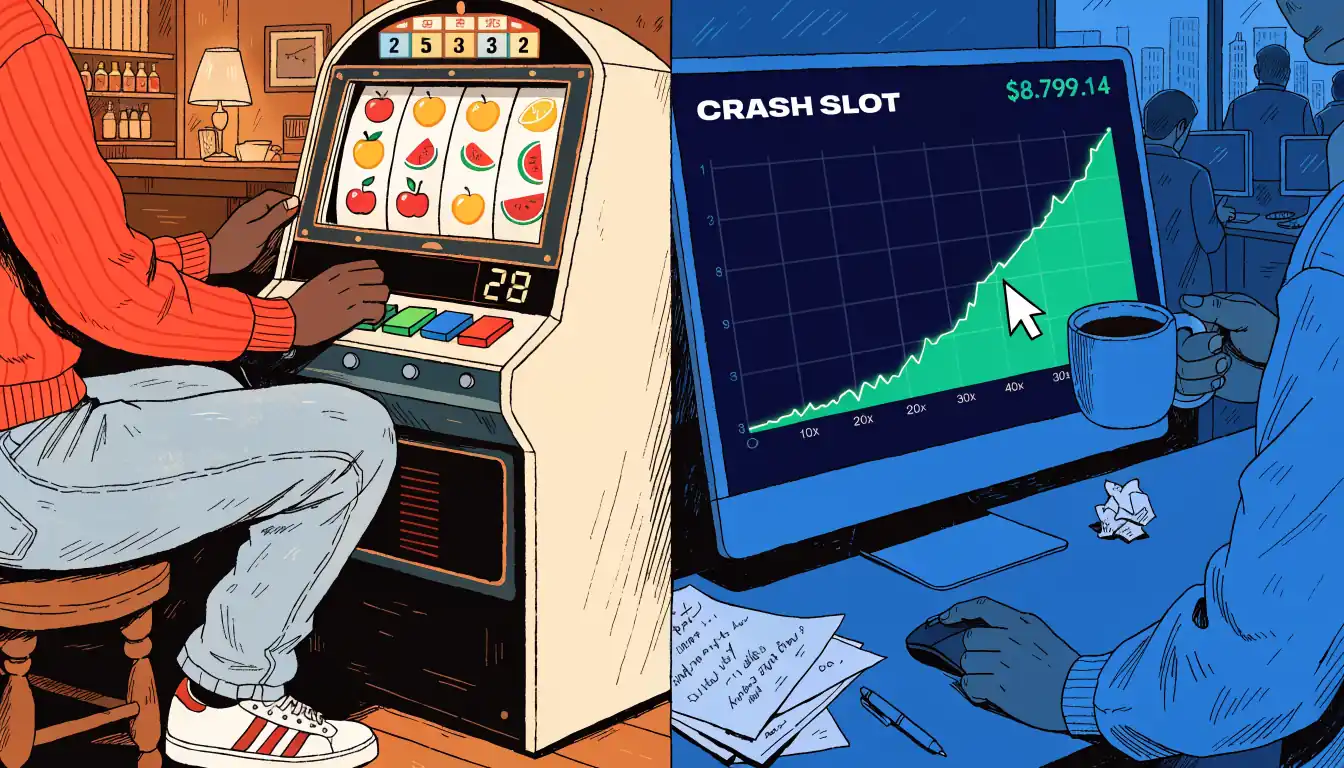
That difference is why crash slots feel more "skill-adjacent" even though the crash point is generated the same way a pokie’s reel is — randomly, with a house edge sitting underneath. The skill is entirely in your exit, never in the odds.
Why Australian law treats them differently
Here’s where it gets murkier than most guides let on. A pokie is unambiguously an online casino game — it sits squarely in the category the Interactive Gambling Act 2001 was built to keep off Australian screens. Crash slots occupy an odder spot. They’re marketed and coded like casino games, run by the same offshore operators, hosted on the same platforms — but the “multiplier you control” framing has let some of them slide into grey territory in advertising and positioning, even though functionally nothing separates them from a casino product once real money’s on the table.
That grey framing doesn’t buy you anything as a player. The Australian Communications and Media Authority has been ordering internet providers to block offshore gambling sites since November 2019, and a crash slot dressed up as a "prediction game" or "multiplier challenge" isn’t exempt from that just because of the label. If ACMA decides a site is offering a prohibited interactive gambling service, it can investigate and push for a block — full stop, regardless of what the game calls itself.
Ads persist
Even if a site is blocked, gambling ads can still appear in Australian feeds because the advertising ban targets “in Australia” rather than “targeting Australia”.
What ACMA can’t do is chase your money if something goes wrong on an offshore crash platform. No refunds, no dispute resolution, no phone call that fixes a frozen withdrawal. That part’s on you and the operator, and the operator is usually somewhere ACMA has no reach.
One more gap worth knowing: ACMA can block a site, but it has no power to force something like Facebook to pull gambling ads aimed at Australians, because of how the advertising ban is worded — "in Australia" rather than "targeting Australia." So you’ll keep seeing crash slot ads in your feed long after the sites themselves get blocked. That’s not an oversight on your part. It’s a gap in the law.
Variety of Crash Games: From Classic to Innovative Variants
The first crash game I ever played was the plain one: a line climbs, a number ticks up, you cash out or you don’t. That’s still the template everything else gets built on. But once you’ve spent a few months poking around this corner of gambling, you notice the "classic" version is really just the entry point. There’s a whole family of variants under the same name, and lumping them together is like calling every card game "poker."
The baseline format
Classic crash is a single multiplier climbing from a fixed starting point, with one decision: cash out now or wait. No paylines, no bonus rounds, no reels. Just a curve and a clock. It’s the version most people mean when they say "crash game," and it’s the one that made the genre recognisable in the first place.
Multiplier races
Then there are races — several multipliers running in parallel, sometimes visualised as tokens or vehicles moving at different speeds, sometimes just as competing numbers on the same screen. The mechanic underneath is identical to classic crash: you’re still betting on when to exit before a collapse. What changes is the presentation, and honestly, the added visual noise makes it easier to lose track of your own cash-out point. I’ve done that. Watched someone else’s line instead of mine and pulled the trigger a beat too late.
Hybrid formats
The more interesting shift is the hybrid stuff — crash mechanics grafted onto other game structures. Some versions borrow the visual language of pokies, with symbols or grids feeding into a multiplier climb. Others lean on side bets layered on top of the main cash-out decision, letting you stake on secondary outcomes while the primary curve is still running. None of this changes the underlying math logic — rising number, single exit point — but it does change how a hybrid format feels to play, and that matters more than people admit when they’re three rounds in and chasing a loss.
Why the variety exists at all
Part of it is just product churn — providers testing what keeps people watching the screen longer. Part of it is regulatory pressure pushing operators to dress up the same mechanic differently. Worth remembering here: the Australian Communications and Media Authority doesn’t just go after the sites themselves. It has the power to issue notices to internet service providers to block offending platforms, and it can also write to software developers and other third parties it considers ancillary to a breach of the Interactive Gambling Act. That reach extends into the tooling behind these games, not just the storefronts. It’s also empowered to start civil proceedings, flag operators’ directors to border agencies, and coordinate with regulators overseas. None of that stops a hybrid variant from existing somewhere offshore — it just means the ecosystem behind these games is less stable than the smooth interface suggests.
What actually varies, and what doesn’t
| Element | Varies between formats | Stays the same |
|---|---|---|
| Visual presentation | Yes — lines, races, grids, tokens | — |
| Side bets / extra layers | Yes — some hybrids add them | — |
| Core exit decision | — | Always one cash-out moment before collapse |
| Underlying “crash” logic | — | Multiplier rises until it stops |
Strip away the skins and the races and the hybrid dressing, and you’re left with the same choice every time: hold, or take the money. Everything else is packaging.
Playing Crash Casino Games for Free: Benefits and Limitations
I burned through a stupid number of "free" credits before I put a cent on the line. Not because I’m patient — because I wanted to see how the curve moves before I trusted it with money.
Free‑play mode does not change the legal status – the operator is still offering an unlicensed gambling service to Australians.
Demo mode exists for a simple reason: it lets a platform show you the graph, the cash-out button, the whole rhythm of the game without any money changing hands. No deposit, no withdrawal, no ID check at that stage. You’re just watching a multiplier climb and clicking a button. That’s it.
Here’s where it gets murky for Australia specifically. Offering online casino gambling here is illegal, and there’s no path to a domestic licence for anyone running one — cash or free-play. So when a demo version sits on the same site as the real-money tables, it’s still part of an operation that has no legal footing to offer that service to Australians. The "free" button doesn’t change what the site is. It just changes whether you’re risking anything in that moment.
What free play actually gets you:
- A feel for volatility. You see how often a round crashes early versus how far it can run before it does — without your bankroll doing the learning for you.
- Interface practice. Auto-cash-out settings, bet sliders, round history — all the clutter you’d otherwise fumble through mid-round with real stakes.
- Zero consequence. You can chase a bad run for as long as you want and lose nothing but time.
What it doesn’t get you:
- Real payout behaviour. Demo credits aren’t money, and nothing about watching fake balance grow tells you how the site handles an actual cash-out request.
- The regulatory reality. Free play doesn’t sit in some safer legal category. The underlying operator is still offering a product that regulators here treat as unlawful — and ACMA has shown it’s willing to issue warning notices and pass matters to the Australian Federal Police when illegal gambling products are offered to Australians.
- Any sense of your own limits. Playing without money on the line tells you nothing about how you’ll behave once you’ve got skin in the game. I found that out the hard way — the demo me and the real-money me were not the same person.
Free mode is a look through the window. It’s not a rehearsal for the real thing.
Crypto‑Powered Crash Casinos: Opportunities and Risks
I moved my first crash bets to crypto because I got tired of waiting on bank transfers to clear before I could chase the next round. That’s the whole pitch, really: deposits and withdrawals move faster when there’s no bank sitting in the middle checking your transaction against a Tuesday cut-off. Whether that’s "faster" in a way that matters to you depends on how often you’re actually cashing out versus just topping up again.
Here’s the part nobody explains until you’ve already sent the funds: paying with Bitcoin or a similar coin doesn’t change what country you’re playing from, and it doesn’t change the law either. Online casino games, crash included, aren’t licensed for Australian players regardless of what currency moves through the platform. Online sports betting is legal here under state and territory licences — crash games sit outside that entirely, crypto or not.
What crypto does change is where you land if something goes wrong. Card payments leave a paper trail your bank can sometimes chase. A blockchain transaction, once it’s sent, is sent. There’s no chargeback, no dispute department, nobody to call. If a platform decides your cash-out request arrived a half-second too late, you’re arguing with a support chat and nothing else.
None of this makes it illegal for you personally to play. It’s not — the law targets the operators offering these games, not the individual sitting at home playing them. That’s a real distinction, and it’s worth knowing so you’re not scaring yourself over something that isn’t actually a legal risk to you.
The regulatory grey area isn’t really about whether you’re allowed to play. It’s about what happens after you’ve played, and crypto strips out most of the usual backstops. Faster in, faster out — but also faster gone, with fewer people to ask questions to when it doesn’t add up.
Crash Casino Strategy, Rules, and Bankroll Management
I used to think crash games were the one corner of a casino where "strategy" actually meant something. Watch the curve, cash out before it dies, repeat. Took me a while to notice that’s not a strategy, it’s a hope with a graph attached.
Bankroll management checklist
- Set your unit size as a fixed percentage of your total bankroll.
- Define a cash‑out rule (e.g., cash out at 2×) and stick to it for a set number of rounds.
- Use stop‑loss and stop‑win limits and treat them as non‑negotiable.
- Split bets when the platform allows it to smooth swings.
Here’s what actually holds up.
Set your unit size before you play, not while you’re playing. Decide what one bet costs you as a fixed slice of whatever bankroll you brought, and don’t touch that number when you’re down. The urge to double up after a loss feels logical in the moment. It isn’t.
Pick a cash-out rule and stick to it for a set number of rounds. Some people bail early and often, some ride longer for bigger multipliers less frequently. Neither is "correct" — the math evens out over time regardless of when you pull the trigger, because the game has no memory of your last round. What matters is consistency, so you can actually tell later whether your approach worked or you just got lucky.

Split bets if the platform allows it. Cashing out part of a stake early and letting the rest ride is a way to bank something without fully committing to the guess. It doesn’t beat the house edge, but it smooths the swings.
Walk in with a stop-loss and a stop-win, and treat both as non-negotiable. Write the numbers down somewhere you’ll see them mid-session. Bankroll and time limits aren’t a nice-to-have — any platform worth using should let you set them, and if it doesn’t, that’s your answer.
The rest is discipline dressed up as maths. If a session stops feeling fun and starts feeling necessary, that’s the signal to stop, not to chase. Gambling Help Online and BetStop exist for exactly that moment — not as a last resort, just as a normal tool.
Bitcoin‑Backed and Balloon Crash Games: How They Work
I got asked once what a "bitcoin crash casino" actually is, as if it’s some separate category of gambling. It’s not. Same crash game, same rising multiplier, same cash‑out button — the only thing that changes is what you’re funding it with. Bitcoin, and sometimes Ethereum, sits where AUD would normally sit.
Crypto doesn’t help
Using Bitcoin or other crypto only changes the payment method; it does not make the crash game legal for Australian players.
The appeal is speed. A crypto deposit lands and you’re playing. No card details, no waiting on a bank to clear anything. That’s the whole pitch, really, and it’s not nothing.
The catch nobody puts in the ad copy: none of these platforms hold an Australian licence, because none can. Online casino games aren’t licensable here at all, crypto or not. So a "bitcoin crash casino" is just an offshore operator that happens to take Bitcoin — same legal grey zone as any other offshore site, just with a different wallet attached. And crypto adds its own layer on top: the coin’s value moves independently of your bet, so a win in Bitcoin terms can look different by the time you’d convert it back.

Balloon-style crash games are a cosmetic variant, nothing more structurally. Instead of a line climbing on a graph, you’ve got a balloon inflating, and it can "pop" at any point instead of "crashing." I’ll admit the first time I played one I actually paid less attention to my cash‑out timing because it felt more like a toy than a betting screen. That’s the actual risk with balloon versions — not the maths, which is identical to standard crash, but the framing. A balloon popping reads as playful. A multiplier crashing reads as losing money. It’s the same event.
Worth saying plainly: neither format is safer just because it looks different or runs on crypto. The odds sit underneath the skin, not in it.
Provably Fair Play in Crash Casinos: How Transparency Is Ensured
The first time someone told me a crash multiplier was "provably fair," I nodded like I understood and then went and looked it up, because I didn’t. Turns out it’s simpler than the name suggests. Before you place a bet, the game generates a hashed result — a scrambled string of characters. You can’t read it, but it exists before your round starts. Once the round ends, the platform reveals the seed that produced that hash. Run it through a checker, and if it matches, the outcome wasn’t picked after the fact to work against you.
That’s the whole point. Not "trust us." Verify it yourself.
Most crash providers running on random number games use some version of this system, though how visible the verification tool is varies a lot. Some bury it in a menu; others put a "verify" link right under the crash graph. If you can’t find any mention of seeds, hashes, or verification anywhere on a site, that’s worth noticing.
I won’t pretend I check the hash every round — I don’t, and most people don’t either. But knowing it’s checkable changes how you read a losing streak. A rigged game and a genuinely random bad run feel identical from the inside. Provably fair tech doesn’t stop you losing. It just means the losing wasn’t decided against you specifically, which, after enough late cash-outs, is oddly reassuring.
Are crypto casinos legal in Australia in 2026?
No, online casino-style games are prohibited federally under the Interactive Gambling Act, and no domestic licence exists for operators to offer them, whether crypto-based or otherwise.
Is online gambling legal in Australia?
Online sports betting is legal under state or territory licences, but online casino games, poker, and in-play betting are prohibited federally.
Are my personal and financial details safe on offshore crash casinos?
Not to the standard you’d expect locally — there’s no Australian regulator between you and the operator enforcing consumer protections, so age checks, data security, and dispute resolution all depend entirely on the offshore platform’s own rules.
What payment methods are available for Australian players at online casinos?
Offshore operators support whatever rails they choose, but your options are constrained by Australian regulations that restrict which payment methods can legally be used for gambling.
Can I play online pokies for free?
You can play free demo or play-money versions, but there are no domestically licensed operators offering real-money online pokies to Australians.
Prepared by the Casino Payments Guide editorial staff.