Casino Dice Games in Australia: Rules and Legal Status
 Available in AU
If you’re exploring dice games online in 2026, it helps to know which casinos back their offer with a real licence, clear bonus terms, and workable deposit limits before you sign up.
License: Curacao · Bonus: up to A$2,000 Operates under a Curacao licence and offers a bonus of up to A$2,000, giving you a straightforward starting incentive.
License: Curacao Gaming Control Board OGL/2023/176/0095 (Hollycorn N.V.) · Bonus: up to A$5,000 + 300 free spins across 4 deposits Licensed by the Curacao Gaming Control Board under Hollycorn N.V., with a sizeable bonus of up to A$5,000 plus 300 free spins spread across four deposits.
License: international iGaming licence – jurisdiction not named in the source · Bonus: 100% up to A$1,000 + 100 free spins, 35x wagering · Payout speed: PayID 1-24 hours · Min. deposit: A$30 (PayID from A$10) Holds an international iGaming licence and pairs a 100% bonus up to A$1,000 with 100 free spins under 35x wagering; PayID withdrawals typically land within 1-24 hours, and deposits start from A$10 via PayID.
License: Curacao Gaming Control Board OGL/2023/174/0082 (Dama N.V.) · Bonus: up to A$5,000 + 300 free spins across 4 deposits Licensed by the Curacao Gaming Control Board under Dama N.V., offering up to A$5,000 plus 300 free spins across four deposits.
License: Curacao eGaming OGL/2024/923/0383 (Antillephone N.V.) · Bonus: up to A$2,000 + 100 free spins across 2 deposits · Min. deposit: A$30 Holds a Curacao eGaming licence via Antillephone N.V. and offers up to A$2,000 plus 100 free spins across two deposits, with a A$30 minimum deposit.
License: Curacao eGaming (Dama N.V.) · Bonus: up to A$10,000 + 180 free spins, 40x wagering Licensed under Curacao eGaming through Dama N.V., with a substantial bonus of up to A$10,000 plus 180 free spins under 40x wagering.
License: Curacao Gaming Control Board OGL/2023/176/0095 (Hollycorn N.V.) · Bonus: up to A$11,000 + 300 free spins (code NEO100) Licensed by the Curacao Gaming Control Board via Hollycorn N.V., offering a large bonus of up to A$11,000 plus 300 free spins when you use the code NEO100.
Bonus: 240% up to A$4,100 + 300 free spins Stands out for a bonus structure of 240% up to A$4,100 plus 300 free spins.
License: Curacao (operating since 2017) · Bonus: 250% up to A$2,000 + 50 free spins on the first of six deposits · Min. deposit: A$20 A Curacao-licensed operator running since 2017, offering a 250% bonus up to A$2,000 plus 50 free spins on the first of six deposits, with a A$20 minimum deposit.
Bonus: 100% up to A$750 + 200 free spins, 35x wagering · Payout speed: crypto 30-120 minutes, fiat 24-72 hours · Min. deposit: A$30 Offers a 100% bonus up to A$750 plus 200 free spins under 35x wagering, with fast crypto payouts of 30-120 minutes or fiat within 24-72 hours, and a A$30 minimum deposit.
Table of Contents
- Online Dice Casino Games in Australia – Legal Landscape
- Dice Game Variants You’ll Find in Australian Casinos
- How to Play Casino Dice Games Online
- What Is a Casino Dice Game? Definitions and Core Mechanics
- Craps and Table Dice Games – Rules and Play Style
- Dice Integrated with Other Casino Games
- Why Casinos Use Dice – Purpose and Appeal
- Basic Rules of Popular Casino Dice Games
- Live Dice Games – What’s Allowed in Australia?
- Where You Can Roll Dice – Land‑Based Casinos and Their Regulations
Online Dice Casino Games in Australia – Legal Landscape
First time I typed “casino dice online” into a search bar, I expected a straight answer. What I got instead was a mess of forum posts arguing with each other. So let’s clear that up before anything else, because the legal picture around online dice games here is genuinely tangled, and most of what you’ll read elsewhere skips the tangled part.
Here’s the short version: online casino-style games — and that includes any dice game running on a random number generator through a casino platform, not just slots or roulette — are prohibited under the Interactive Gambling Act 2001. That’s the federal law. It doesn’t care whether the game involves cards, a wheel, or a pair of dice. If it’s a casino game offered online to someone sitting in Australia, it falls under the ban. There’s no local licence you can point to that makes an online dice casino game legal to offer here, because that licence doesn’t exist. Nobody domestically operating a real-money online casino has one, because it can’t be issued.
The Interactive Gambling Act bans online casino-style games for operators, but it does not criminalise Australian players who access offshore sites.
That’s the part people get wrong constantly. They assume "illegal" means illegal for them, the player, rolling dice on their phone at midnight. It doesn’t work that way. The law is written to target operators — the businesses offering the games — not the individual sitting on the couch playing them. So if you’re an Australian resident playing craps or Sic Bo on an offshore site, you’re not breaking the law. The site offering it to you, on the other hand, technically is, at least under Australian rules. Which is a strange position to be in as a player: legal for you, illegal for them, and nobody’s coming to arrest either side over a dice roll.
Who’s actually enforcing any of this
There isn’t one office you can call about gambling in Australia. That’s not an exaggeration — there is no single overarching statute or single body that governs the whole thing. It’s split between federal and state/territory levels, and each level does something different.
At the federal level, the Australian Communications and Media Authority — ACMA — is the one enforcing the Interactive Gambling Act. Their job, broadly, is going after the operators, not the players. They can act against offshore platforms offering online casino games to Australians, which functionally covers online dice games too, since dice games are just another catalogue entry inside the same casino software packages as slots and roulette.
The Australian Communications and Media Authority (ACMA) is responsible for enforcing the Interactive Gambling Act, focusing on the operators that offer online casino games to Australians.
Below that, every state and territory runs its own gambling regulator. Victoria has the Victorian Gambling and Casino Control Commission, which — worth noting — doesn’t just watch Victorian operators. It monitors wagering service providers across the country for compliance with the National Consumer Protection Framework, regardless of where those providers are actually based. Other states have their own equivalents doing similar work within their borders.

Then there’s the Northern Territory Racing Commission, which occupies an odd but important spot. It’s become what people in the industry call Australia’s de-facto online gambling regulator — not because it was designed for that role, but because it licenses most of the national online bookmakers, who base themselves there for the lower tax rate. That’s sports betting and racing, mostly, not casino dice games, but it explains why the NT keeps coming up in any conversation about who actually oversees online gambling in this country. It’s a patchwork held together by tax incentives and jurisdiction, not a single coherent system.
Where dice games actually sit in this picture
None of these regulators — ACMA, NTRC, VGCCC, or the state bodies — license domestic online dice casino games, because none of them can. The gap that exists for online casino games generally applies just as much to dice. There’s no Australian-licensed online dice casino, full stop. Every dice game you’ll find running through a browser or an app, whether it’s a digital craps table, a Sic Bo variant, or a dice-based slot hybrid, is coming from an offshore-licensed operator. Malta, the UK, or similar jurisdictions issue the licences these sites operate under — not Australia.
That’s worth sitting with for a second, because it changes what "legal" even means here. The game itself isn’t illegal for you to play. The operator offering it isn’t licensed to offer it to you under Australian law. And no domestic regulator has the authority to change that by issuing a local licence, because the Interactive Gambling Act doesn’t allow one to exist. Three separate facts, all true at once, and together they explain why the whole topic reads as contradictory if you only catch half of it.
I used to think "regulated" meant something specific and stable, like a stamp you could check. Not here. Not for this.
The practical takeaway

If you’re looking to play online dice games as an Australian resident, understand you’re operating in a legal space where you personally aren’t the target of enforcement, but the platform is unlicensed by Australian standards no matter what it tells you on its homepage. There’s no domestic seal of approval to look for, because the thing that would carry that seal — a locally licensed online casino — doesn’t exist. Any claim to the contrary is either confused or dishonest.
What does exist is a layered enforcement structure aimed at the supply side: ACMA at the federal level chasing operators and their infrastructure, state-based bodies like VGCCC watching compliance more broadly, and the NTRC sitting in its unusual position mostly around sports and racing licensing rather than casino products. None of them are positioned to make an online dice game "legal" in the domestic sense, and none of them are coming after you for rolling virtual dice on an offshore site.
It’s a legal landscape built out of gaps as much as rules. Knowing where those gaps are matters more than memorising the name of any one regulator.
Dice Game Variants You’ll Find in Australian Casinos
The word "casino dice game" covers more ground than most people expect. When I first went looking, I assumed it meant one thing — craps, the game with the crowd yelling around a table in every movie set in Vegas. Turns out that’s just the tip of it. Once you actually start digging, you find a handful of distinct families of games, and each one plays completely differently even though they all live and die on the same two cubes.
Craps — the original
This is the one everyone pictures. A shooter rolls, the table bets on outcomes — pass, don’t pass, come, place bets on specific numbers — and the whole thing runs on a shared pot of tension because everyone at the table is riding the same roll. It’s social in a way most casino games aren’t. You’re not playing against the house in isolation, you’re playing alongside strangers who are all hoping for the same seven.
Sic Bo
Less known outside Asian-influenced markets, but it’s out there — three dice instead of two, and a betting layout that looks intimidating the first time you see it. Combinations, totals, specific triples. I lost money on this faster than on anything else purely because I didn’t understand the payout structure before I sat down. Lesson learned: read the table layout twice before you put chips anywhere near it.
Chuck-a-Luck (Birdcage)
An older, simpler cousin of Sic Bo. Three dice spun in a wire cage instead of rolled. You bet on numbers coming up, the cage turns, dice settle. It’s slower, lower-stakes in feel, and you don’t see it as often — but when you do, it’s usually a nod to a more traditional style of table gaming.
Dice-based slot hybrids

This is where things get interesting, and where a lot of Australian venues have shifted focus. Instead of a wheel or reels, some modern machines use a dice mechanic to determine outcomes — the visuals borrow from slots, but the underlying random element is dice rather than spinning symbols. It’s a hybrid built for players who like the ritual of a table game but want the pace and solo play of a machine. I’ll be honest, the first time I sat down at one I didn’t even realise it was dice-driven until a few rounds in — the dressing is pure pokies, the mechanics underneath are borrowed from the table.
Banka Francesa and regional variants
Less common, more of a curiosity if you travel or if a venue has decided to diversify its floor. Same core idea — dice determine the win, rules and betting spreads differ. You won’t find these everywhere, but they exist, usually tucked into a corner of a larger table games section.
Where you’ll actually find these
Land-based venues in Australia tend to carry craps and Sic Bo as their table dice staples, with the slot-hybrid machines sitting on the gaming floor alongside pokies rather than in the table pit. That’s a real physical and cultural split — table dice games belong to the pit, with a croupier running the game and a crowd around the rail; the hybrid machines belong to the machine floor, solitary, screen-based, no crowd required.
Land‑based casinos in Australia offer craps and Sic Bo at the tables, while online dice games are only available through offshore‑licensed platforms.
Online is a different story entirely, and worth being upfront about. It is illegal to offer online casino gambling in Australia, and there’s no path to get a domestic licence to run one — so any digital version of craps, Sic Bo or a dice-slot hybrid you come across is going to be running out of an offshore jurisdiction, not an Australian one. That doesn’t mean playing one is illegal for you personally — it isn’t; the law is aimed at operators, not at the person rolling the dice from their couch. It just means the variety you find online sits in a completely different regulatory space than the machines on a casino floor in Sydney or the Gold Coast, and that distinction matters more than which variant you pick.
Picking a lane
If you’re new to all this, the practical difference between these variants comes down to pace and involvement:
| Variant | Feel | Best for |
|---|---|---|
| Craps | Social, table-driven, shared outcomes | Players who like the crowd energy |
| Sic Bo | Fast, layout-heavy, more combinations to track | Players who enjoy working out odds |
| Chuck-a-Luck | Slower, simpler, old-school | Players easing into dice games |
| Dice-slot hybrids | Solo, screen-based, pokies pacing | Players who want dice without the table |
None of these need you to master a rulebook before you try them — but knowing which family you’re sitting down to plays a bigger part in whether you enjoy the session than most people assume walking in. I spent my first few sessions bouncing between craps and Sic Bo without realising they demanded completely different instincts, and it showed in how fast my money disappeared.
How to Play Casino Dice Games Online
The first time I tried to play craps online, I spent about ten minutes just looking for the table because I expected a lobby that would tell me what’s what. It didn’t. You get a search bar and a wall of thumbnails, and dice games sit buried under a hundred pokies. So here’s the actual process, not the marketing version.
Setting up an account
Since there are no domestically licensed online casinos taking Australian players, every platform you’ll land on is offshore — usually licensed somewhere like Malta or the UK. Registration looks the same everywhere: email, name, date of birth, and a password. You’ll need to be 18 or over; every legitimate site checks this, and if one doesn’t ask, that’s a red flag, not a convenience.
Before you deposit anything, expect to go through identity verification at some point — a photo ID, sometimes a proof of address. It’s not optional and it’s not the casino being difficult; it’s how they comply with anti-money-laundering rules. Do it early. I once left it until my first withdrawal and sat on a "pending" screen for days because I hadn’t uploaded a document I could’ve sorted at sign-up.
Depositing
Payment options vary by operator, but you won’t find credit cards or crypto accepted for deposits or bets under Australian rules — so whatever method you use, it’ll be something else: a debit card, an e-wallet, a bank transfer. Whatever the site lists, check it’s actually on offer before you get attached to a bonus tied to a method you can’t use.
Speaking of bonuses — any offer should show you the wagering requirements before you opt in, not after. If a deposit bonus page doesn’t spell out the conditions clearly, that’s worth noticing before you click "claim."
Finding the dice games
Once you’re in, don’t expect a "dice" category front and centre. Use the search function and type the game name directly — craps, Sic Bo, whatever you’re after — because lobbies are built around slots, not table games. Table games or "Live Dealer Games" sections are usually where they hide.
Playing
For most online dice games, the process is:
Playing an online dice game
Pick your stake before the roll — table minimums and maximums are set by the game.
Place your bet on the layout (pass line, specific numbers, etc.).
Click “roll”, or watch the live dealer roll physical dice on camera.
Bets settle automatically based on the outcome, and winnings are added to your balance.
- Pick your stake before the roll — table minimums and maximums are set by the game, not negotiable mid-round.
- Place your bet on the layout (pass line, specific numbers, whatever the game calls for).
- Click roll, or in live dealer versions, watch the croupier roll physical dice on camera.
- Bets settle automatically based on the outcome, and winnings land in your balance straight away.
The random number generator versions are instant — roll, result, next round. Live dealer dice games run on a timer between rounds since there’s an actual person and actual dice involved, so the pace is slower and closer to what you’d get at a physical table.
A few things I wish someone had told me early

Set a deposit or loss limit before you start, not after you’re three rounds deep and annoyed. Most platforms let you set these limits somewhere in account settings, and it’s worth doing on day one rather than after a bad session.
Keep an eye on the house edge listed for each bet type if the game shows it — some dice bets are far worse value than others, and the interface won’t warn you, it’ll just let you place it.
And if a session stops being fun and starts being something you’re chasing, Gambling Help Online and BetStop exist for exactly that, not as a footnote nobody reads but as an actual option.
What Is a Casino Dice Game? Definitions and Core Mechanics
Strip away the felt tables, the chips, the shouting — a casino dice game is just this: a bet placed on the outcome of one or more thrown dice, where the die itself is the random number generator. No cards, no reels, no cameras tracking a wheel. Just probability, expressed in six faces (or however many the variant uses).
That’s the whole definition. Everything else — craps, sic bo, dice-based slot hybrids — is a variation built on top of that one mechanic.
The core mechanic, broken down
A dice game needs three things to exist as a casino product:
- A randomiser — the die or dice, physical on a table, or a “random number game” running behind an RNG on your screen.
- A set of outcomes with known odds — every face has a fixed, unchangeable probability. Two dice thrown together produce a spread of totals, and some totals are far more likely than others, which is exactly what shapes the payout structure.
- A wager tied to a specific outcome — you’re not betting on the dice in the abstract, you’re betting on what they’ll show, or what combination they’ll add up to.
That third point is where I got confused early on. I assumed a "dice game" meant one bet, one roll, done. It doesn’t. Most dice games let you stack several bets on the same roll — betting the total will land in a range, betting on a single number appearing, betting on a repeat. The house edge on the site’s site is baked differently into each of those side bets, which is why two players can bet on the same roll and get wildly different value without either of them doing anything "wrong."
Physical dice vs digital dice
Land-based tables use actual thrown dice — physics, momentum, a wall to bounce off. Online, you’re looking at a random number game simulating that throw, or, in the case of live dealer games streamed from a studio, an actual croupier rolling actual dice on camera while the result gets read and logged digitally. Both count as casino dice games. The mechanic — die face determines payout — doesn’t change; only what’s generating the randomness does.
I used to think the digital version was somehow "less real" than a physical roll. It isn’t less real, it’s just less visible. You can’t watch the die tumble, so you’re trusting the random number game to behave the way a physical die would over time. That trust is really the entire difference between the two formats.
What makes it a "casino" dice game specifically
Plenty of dice games exist outside casinos — backyard craps, board game dice, drinking games. What turns a dice game into a casino dice game is structure: fixed odds set by the house, a defined house edge built into every bet type, and a payout table that doesn’t move regardless of who’s rolling or how they feel about it. There’s no skill adjustment, no reading an opponent. The die doesn’t know your history or care about your streak.
Live dealer dice games
Live dealer dice games stream a real croupier rolling physical dice. The randomness comes from the actual dice, but the betting and settlement are handled by the online platform, blending the feel of a land‑based table with the convenience of online play.
That’s also why dice games get lumped in with roulette in a lot of people’s heads — same category of thinking applies. Fixed odds, no influence over the outcome, payout determined entirely by probability rather than decision-making. The only real decision a player makes is which bet to place before the die is thrown, not what happens after.
Where this gets misused
I’ve seen dice-themed pokies marketed as "dice games" when the dice are purely decorative — a bonus round trigger sitting on top of a slot mechanic that has nothing to do with actual dice probability. That’s not dishonest exactly, but it’s not the same product. A genuine casino dice game means the dice are the randomiser determining your payout, not a graphic layered over one.
Craps and Table Dice Games – Rules and Play Style
The first time I stood at a craps table, I understood maybe a third of what was happening. Chips flying across felt, a stickman calling numbers, someone next to me cheering because the shooter "made a point." I nodded like I got it. I didn’t.
Craps is built around one core sequence: the come-out roll. The shooter rolls two dice, and if it lands on seven or eleven, the pass line wins straightaway. Roll a two, three, or twelve, and pass line bets lose on the spot — that’s "craps," which is where the game gets its name. Anything else — four, five, six, eight, nine, or ten — becomes "the point." From there, the shooter keeps rolling until either that same number comes up again (pass line wins) or a seven shows (pass line loses, and the dice move to the next shooter).
That’s the skeleton. Everything else at the table is layered on top of it.
The bets that actually matter
Pass line and don’t pass are the two you’ll use almost every time you play, because they carry a relatively low house edge compared to the side bets scattered around the layout. Once a point is established, you can also back it with odds — an additional wager behind your original bet that pays out true odds with no house edge attached, which is about as close to a fair bet as a casino floor gets.
Always check the house edge listed for each bet type; some dice bets offer significantly worse value than others.
Then there’s the rest: come bets, place bets, field bets, hardways, any-craps, and a handful of proposition bets that look tempting because the payouts are bigger. They’re bigger for a reason. The house edge on most proposition bets is significantly steeper than on the pass line — casinos aren’t printing those numbers on the felt as a public service.
Other table dice games
Craps isn’t the only dice game you’ll find on a table layout. Sic Bo uses three dice instead of two, and players bet on combinations, totals, or specific numbers appearing — it’s simpler to grasp than craps but the odds skew hard toward the house on most bet types. You’ll also come across variations that use a dice-based wheel or shaker cage rather than a hand roll, mostly there to speed up the game and remove any argument about how the dice were thrown.
What playing it actually feels like

Table dice games are social in a way that slots and even blackjack aren’t. People bet on your roll, not just their own. There’s a rhythm to it — the stickman’s chant, the collective groan when a shooter "sevens out," the way strangers high-five over a number they didn’t even bet on directly. That’s the appeal, and it’s also the trap. It’s easy to get swept into betting bigger because the table’s excited, not because the bet makes sense.
The house edge doesn’t care about the mood at the table. Pass line bets stay reasonable regardless of how loud everyone’s cheering. Proposition bets stay bad regardless of how confident the shooter looks.
A few things I wish someone had told me early
- The don’t pass bet is the mirror of pass line and is often treated as “betting against the table” — it’s not against the rules, it’s just against the room’s mood.
- Taking odds behind your point is where the actual value is; skipping it because it seems complicated leaves money on the table, so to speak.
- Hardways and any-craps bets look exciting on the felt because of the payout multiples advertised next to them — that excitement is the entire sales pitch.
None of this changes based on where you’re rolling. The mechanics of the point, the come-out roll, and the odds bet are identical whether you’re at a physical table or clicking through an online version — the layout doesn’t care about your postcode, only the math does.
Dice Integrated with Other Casino Games
Somewhere along the way, dice stopped staying in their own lane. I remember loading up what I thought was a straightforward slot and realising halfway through the bonus round that the whole thing was decided by a pair of animated dice bouncing across the screen. No reels involved in that part at all. Just dice, dressed up as a slot feature.
That’s the trend worth pointing out here: dice mechanics get bolted onto games that aren’t dice games at all. A pokies title might use a dice roll to trigger a multiplier or unlock a bonus wheel. A card-based table game might throw in a side bet resolved by a dice throw instead of a card draw. None of this is "craps" or any classic table dice game — it’s dice used as a randomness engine inside something else, because the visual of two cubes tumbling reads as fair and instant in a way a hidden algorithm doesn’t.
You’ll also find hybrid products that don’t fit neatly into "slot" or "table game" categories at all. Some are built around dice from the ground up but borrow paylines or symbol multipliers from slot design. Others sit closer to a board game, where dice determine movement across a track and each stop triggers a different mini-feature. I’ve played a few of these expecting something closer to craps and ended up in what was basically a slot with a dice skin on it — same random number generation underneath, just a different face on the outcome.
Hybrid dice games
Dice mechanics are often integrated into non‑dice games, such as slots that trigger bonuses with a dice roll or card games that use a dice‑based side bet. Providers like Pragmatic Play and NetEnt include these features to add variety while keeping the underlying random‑number‑generator logic.
Providers like Pragmatic Play, Microgaming, NetEnt and Evolution Gaming have all put out titles that lean on this crossover in one way or another, whether it’s a dice-triggered bonus in a slot or a live-style game where dice replace cards as the resolution mechanic.
What ties all of this together isn’t the dice themselves — it’s that the outcome is still governed by the same random number games logic as everything else on the platform. The dice are a presentation choice, not a different kind of math. Worth knowing before you assume a "dice bonus" behaves like a table game just because it looks like one.
None of this changes what’s legally on offer to Australian players — that’s a separate question covered elsewhere. Here it’s just about recognising the shape these hybrids take when you stumble into one.
Why Casinos Use Dice – Purpose and Appeal

Dice are the cheapest honesty a casino floor has. No screen, no chip, no algorithm — just two or six numbered cubes bouncing off felt. That’s exactly why casinos keep them around. A dice game asks nothing of the player except to watch it land, and the physical randomness feels harder to argue with than a spinning reel, even when the house edge behind it is doing the same job as everywhere else.
There’s also the weight of tradition. Craps didn’t get bolted onto casino floors because operators ran out of ideas — it survived because people already knew how to play it before they walked in. A pit boss doesn’t have to explain dice to anyone standing near the table. That familiarity is worth something to a venue: it fills a table faster than a game nobody’s seen before.
Then there’s the social pull, which is really where dice earn their spot. A slot machine is a private conversation between one player and one screen. A dice table is a crowd. People lean in, groan together, cheer a stranger’s roll they have money riding on. Casinos know that noise sells more than any single game does — it pulls other players over to see what’s happening. You don’t get that from a pokie bank, no matter how bright the lights are.
Randomness plays a quieter role too. Every casino needs outcomes players can’t predict and can’t manipulate, and dice deliver that without needing a random number generator or an audit trail behind glass. It’s randomness you can see happen in front of you, which matters more than it sounds — I’ve watched people trust a bad run on dice long after they’d have stormed off a slot for the same losses, purely because they saw the cube land wrong themselves instead of trusting a machine to tell them.
Engagement is the last piece, and it’s not subtle. Dice games let players make their own calls mid-round — pass, don’t pass, hard ways — instead of just pressing a button and waiting. That sense of a decision, even a small one, keeps people at the table longer than pure chance games usually do.
Basic Rules of Popular Casino Dice Games
I used to think "rules" meant one thing across every dice game. It doesn’t. Craps alone has half a dozen bet types stacked on top of each other, and the sic bo table looks nothing like it, even though both run on nothing but dice and probability.
Still, strip away the table felt and the betting boards, and the core logic repeats itself in every version:
Craps — a shooter rolls two dice. The first roll ("come-out roll") sets the tone: hit a 7 or 11 and pass-line bets win outright; hit a 2, 3, or 12 and they lose. Anything else becomes "the point," and the shooter keeps rolling until that number comes up again (a win for pass-line bets) or a 7 shows first (a loss).
craps
A tabletop dice game where two dice are rolled; the outcome of the “come‑out” roll determines whether a point is set, after which the shooter continues rolling until the point or a seven appears.
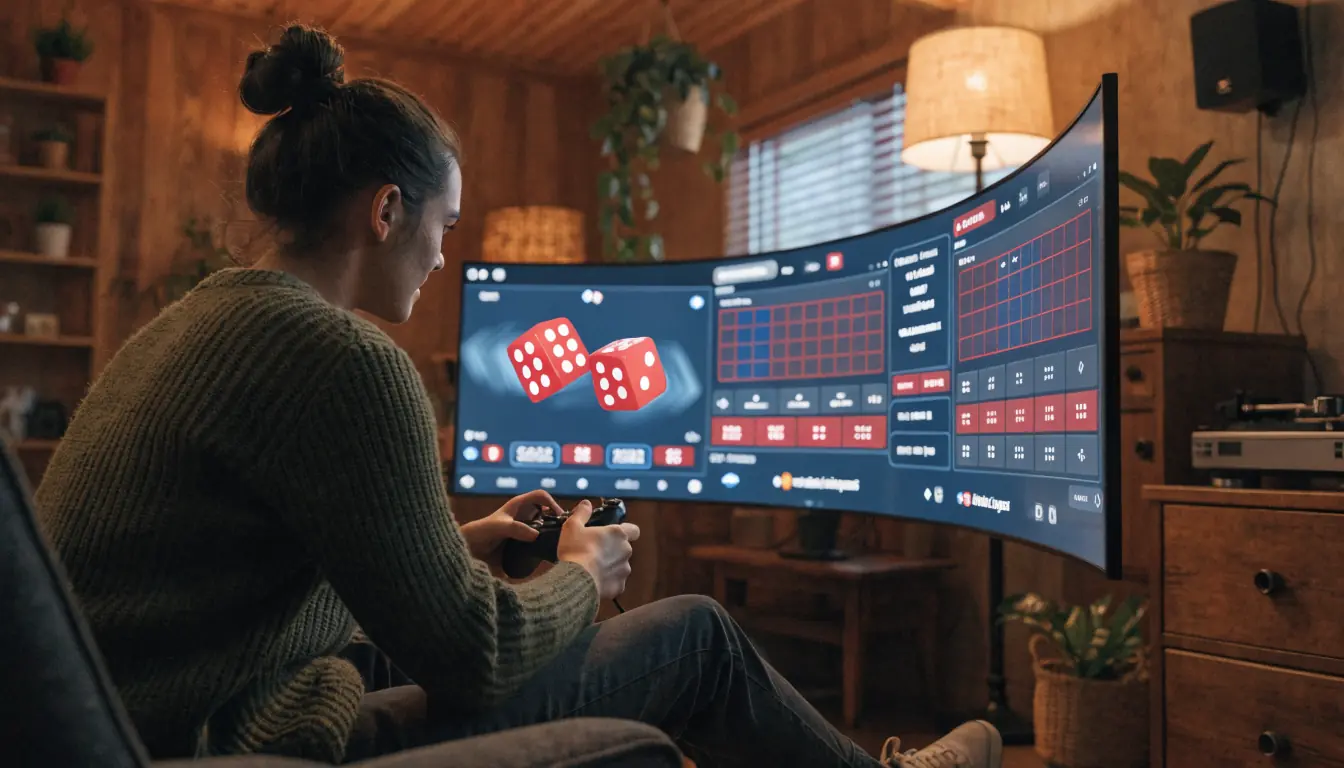
Sic bo — three dice, one roll, decided in seconds. You bet on totals, specific combinations, or single numbers appearing on one, two, or three of the dice. No shooter, no sequence — just the outcome of that one throw.
Simpler dice-based side games — usually built around guessing whether a total will land high or low, odd or even, or matching an exact number. These strip out the multi-round structure of craps entirely.
What stays constant everywhere:
- The dice themselves are the random element — nothing is pre-determined by the platform once the roll happens.
- Bets are placed before the roll (or before the sequence starts in craps), not after.
- Payouts scale with how specific your bet is — betting on an exact triple pays more than betting on “high or low” because it’s harder to hit.
None of this replaces sitting at a table or trying a demo round first. But knowing which bet you’re actually making — not just clicking the highest number on the board — saves you from losing money on bets you didn’t understand.
Live Dice Games – What’s Allowed in Australia?
Here’s where things get confusing fast, so let me untangle it. "Live dice" usually means a real croupier rolling real dice, streamed to your screen — not a random number generator pretending to be one. Sounds simple. It isn’t.
The law draws a line around in-play betting, not around dice specifically. Live, in-play online betting is illegal in Australia. That covers any bet placed on an outcome after the action has already started — including a live-streamed dice round where you’re wagering as the croupier rolls.
Oddly, live betting by phone is legal. You can ring up and place an in-play bet the old-fashioned way, but you can’t do the online equivalent through a casino live dealer stream.
So what does that leave for dice? Static online dice games — the ones where you place your bet, then the roll happens — sit in a different bucket entirely, covered in the legal landscape section above. Live-streamed, in-play dice betting doesn’t get that pass. No offshore "live dealer" dice table changes that distinction, no matter how it’s marketed.
Where You Can Roll Dice – Land‑Based Casinos and Their Regulations
If you actually want to throw dice for real, forget your laptop. Craps tables exist in Australia, but only inside physical casinos, and every one of those venues answers to a state regulator, not to Canberra.
That split matters more than it sounds. The federal Interactive Gambling Act and ACMA police online gambling. Land-based casinos live in a completely separate world: they’re licensed and watched by state government regulators and law enforcement agencies. Two systems, two sets of rules, almost no overlap.
Bodies like the VGCCC in Victoria or Liquor & Gaming NSW run that side — venue licensing, floor inspections, compliance checks on the actual tables and staff. Real authority, real teeth, inside their own state.
Step outside a casino floor, though, and that power thins out fast. The same regulators that can shut down a table for a breach have limited power over offshore online casinos. Different jurisdiction, different rules, no reach.
So the honest way to put it: rolling dice legally and in person means walking into a licensed venue, not opening a browser tab. Two different rulebooks, and nobody pretends otherwise.
Are crypto casinos legal in Australia in 2026?
No. The Interactive Gambling Act 2001 prohibits offering online casino games to anyone in Australia, which covers all crypto casinos. The law targets the operators providing these services, not you as a player, but no domestic licence exists to make any such platform legal.
Which software providers power the recommended online casinos?
No domestic Australian online casinos exist, so none are powered by locally licensed providers. Any online dice or casino games you access are run by offshore operators holding licences from jurisdictions like Malta or the UK.
What advanced security features are used in Australian casinos?
Land-based casinos are regulated by state government bodies, but no comparable domestic online casino security framework exists. Offshore platforms operate under foreign jurisdictions like Malta or the UK, so any security measures fall under those external regulatory standards.
What are the common responsible‑gaming utilities offered by reputable online casinos?
Domestic online casinos are prohibited under the Interactive Gambling Act 2001, so there are no locally licensed platforms offering responsible-gaming utilities. Any such features you encounter come from offshore operators and are governed by their foreign licensing jurisdictions.
What is the role of the Australian Ad Observatory in monitoring online gambling ads?
The Australian Communications and Media Authority (ACMA) enforces the Interactive Gambling Act 2001 and can request ISP blocking of illegal offshore gambling sites. However, ACMA lacks the power to make platforms like Facebook block gambling advertisements targeting Australia.
What is the proposed timeline for implementing the gambling advertising ban in Australia?
No specific timeline for a gambling advertising ban is available. While ACMA actively blocks illegal gambling websites and over 220 illegal services have exited the market, its authority over advertising is currently limited by the wording of the law.
Written by the editors at Casino Payments Guide.