Best Real Money Online Casinos in Australia
 Available in AU
Table of Contents
- Understanding the Australian Online Casino Landscape
- How We Pick the Best Real‑Money Online Casinos for Australians
- Playing for Real Money: What You Need to Know
- Game Types and Their Return‑to‑Player (RTP) Rates
- Winning Strategies with Popular Slots
- Mobile Gaming: Playing on the Go
- Live Casino Experience: What to Expect
- Getting Started: How to Play at an Online Casino
- Slot Machines: The Most Popular Choices
- Top Picks for Australian Players in 2026
Understanding the Australian Online Casino Landscape
First thing to get straight, because it trips up almost everyone I’ve talked to about this: playing at an online casino as an individual in Australia is not illegal. You can lose money to pokies at 2am on your phone and you haven’t broken any law by doing it. What’s illegal is on the other side of the screen — running the casino, not playing at it.
That distinction matters more than it sounds like it should, because it’s the whole reason this space looks the way it does.
Why there’s no such thing as a licensed local casino
Under the Interactive Gambling Act 2001, no operator based in Australia can be licensed to offer online casino games — slots, roulette, blackjack, any of it — to Australian residents. Doesn’t matter how big the company is, how much money they throw at lawyers, or how "compliant" their marketing claims to be. There is no licence to apply for. It doesn’t exist. So when you see a site claiming to be an "Australian-licensed online casino," that’s not a credential, that’s a red flag. I fell for something close to this early on — not quite that exact wording, but a site that talked a big game about being "fully compliant with Australian standards" without ever saying which regulator actually stood behind it. There wasn’t one. There never is, for a domestic operator running casino games.
Offshore Casinos
Playing at offshore‑licensed casinos is legal for you, but they operate outside Australian regulatory oversight, so you have no local recourse if something goes wrong.
Sports betting and lotteries are a different story entirely — those get licensed properly through state and territory frameworks, and you’ll see real registration details for those operators. Casino games just aren’t part of that system, full stop.
So every real-money casino you’ll find operating for Australians is offshore. Malta, Curaçao, and a handful of other jurisdictions issue the licences that actually apply here. That’s not a workaround or a grey-market trick — it’s just where the entire industry sits, because Australia deliberately built a wall around this specific category of gambling and told operators to stay on the other side of it.
What "offshore" actually means for you

Here’s where I had to unlearn some assumptions. I used to think "offshore" meant sketchy, like the casino was hiding from something. It’s simpler than that — it means the casino is licensed and regulated somewhere other than Australia, because Australia isn’t handing out licences for this kind of gambling to anyone, local or foreign.
The practical consequence: offshore casinos sit outside Australian regulatory oversight entirely. That includes BetStop, the national self-exclusion register. If you’ve put yourself on BetStop to keep away from licensed Australian betting products, that registration has no reach into an offshore casino site. Nobody there is checking your name against it. Whatever protection BetStop gives you, it stops at the border of what Australia actually licenses.
This cuts both ways. It means there’s no local body you can complain to if a casino stiffs you on a withdrawal, no Australian ombudsman who’ll pick up the phone. Whatever protection you get comes from the licensing jurisdiction the casino actually operates under, and from how carefully you picked the site in the first place — which is exactly what the next section digs into.
The blocklist, and what it doesn’t do
The Australian Communications and Media Authority has the power to order internet service providers to block access to gambling sites operating without the right approvals. I’ve had it happen — clicked a bookmarked link one evening, got nothing, and eventually worked out the domain had been added to a block order and my ISP had quietly cut it off at the network level.
The ACMA blocklist only stops your ISP from reaching the domain; it does not freeze or confiscate any funds you have in an offshore casino account.
What surprised me was what that block didn’t do. I half expected my account balance to be gone, like the block reached into the casino’s servers somehow. It doesn’t work that way. The ACMA blocklist operates at the network level only — it stops your ISP from connecting you to the site, full stop. It has no ability to freeze or seize whatever’s sitting in a casino account. Whatever balance you had is still exactly where it was; you just can’t get to it through that particular domain anymore. Casinos that get blocked typically shift to a new domain, and players end up hunting down the current working address. It’s an annoyance, not a wipeout — but it’s also a decent argument for not leaving money sitting in an account longer than you need to.
Money in, money out
Getting funds into a casino account and getting winnings back out isn’t as frictionless as it is for, say, online shopping, and Aussie players run into a couple of specific walls.
Some Australian banks block debit card payments to gambling sites outright — you’ll get a declined transaction with no explanation beyond "your bank has blocked this." I’ve had a card just stop working at a checkout page for no reason I could see until I called the bank and got the real answer. Whether a particular bank does this isn’t consistent, so it’s worth knowing it’s a possibility before you assume your card is the problem.
Credit Cards Banned
Using credit cards for online gambling is prohibited in Australia as of June 2024 – attempting to do so can result in transaction declines and potential account issues.
Credit cards are further along the same path — as of June 2024, credit cards can’t be used for online gambling in Australia at all. That’s not a bank being cautious, that’s the current rule. If you’re still expecting to fund an account with a credit card because that’s what worked a couple of years back, it won’t anymore, and PayID or crypto deposits have become the more reliable route for a lot of players for exactly this reason.
Who’s actually allowed to play
One thing that isn’t up for debate anywhere in this landscape: age. The legal gambling age in Australia is 18, for pokies down at the pub and for anything you’re doing through a screen. Every legitimate casino operating here checks this during account verification, and any site that doesn’t ask is telling you something about how seriously it takes the rest of its obligations too.
Where this leaves you
Put it together and the shape of the market is this: you’re free to play, nobody local can legally offer you casino games, and every option on the table is licensed somewhere else. None of that is a problem to be solved — it’s just the terrain. The actual work is in figuring out which offshore-licensed sites are worth your money and which aren’t, and that’s not a legal question anymore, it’s a due-diligence one.
That’s the part I got wrong for longer than I’d like to admit. I spent ages worried about whether I was "allowed" to be doing this at all, when the real risk the whole time was picking a badly-run offshore site over a well-run one. Legality was never the issue. Quality was.
Which is exactly where we’re headed next — how to actually tell the two apart.
How We Pick the Best Real‑Money Online Casinos for Australians
I’ve lost count of how many "top casino" lists I opened before realising most of them were written by someone who never made a deposit. You can tell within a minute — the bonus terms are vague, the "trusted operator" has no licence number anywhere, and the game list is copy-pasted from a press release. Sorting through this mess takes actual time, and there’s no shortcut for it. That’s the part nobody tells you: the market is big, the platforms range from genuinely solid to actively shady, and you find that out the hard way unless someone’s already done the digging.
That’s what this section is — the digging, laid out so you don’t have to repeat it.
What we actually check
Since there’s no local licensing body to lean on and no public registry to cross-reference against, the checks have to happen at the source: the casino’s own site, its terms, and how it behaves once you’re a real player rather than a visitor.
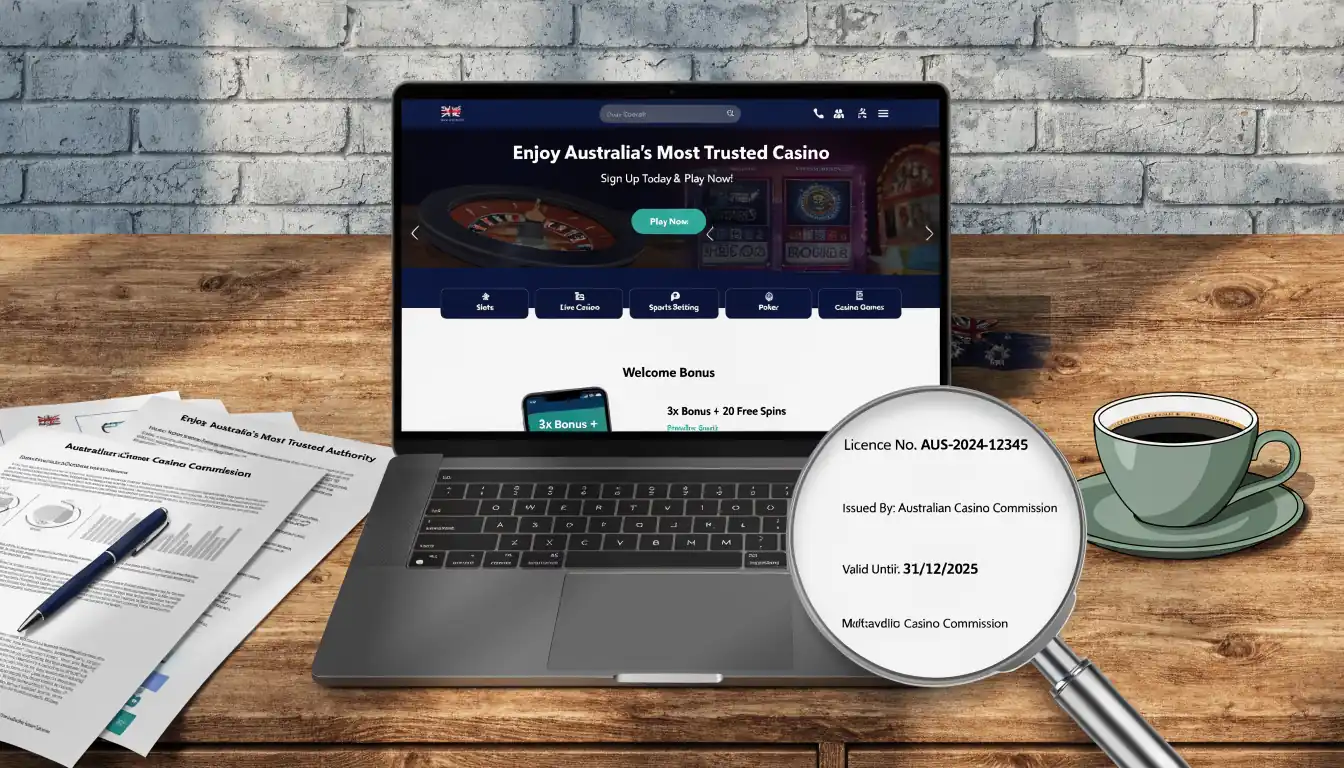
Licensing and operator transparency. We look for a clearly stated regulator and licence details, usually in the footer or the "About Us" page — not buried three clicks deep, not vague ("fully licensed and regulated" with nothing to back it). If a casino can’t tell us who it answers to, it doesn’t make the list. This isn’t a formality; it’s the difference between a business that expects scrutiny and one that’s hoping you won’t look too closely.
Game providers. We check who actually supplies the games. Recognisable studios mean the RNG has been tested and the titles are built to a standard. An unfamiliar provider name isn’t automatically a red flag, but a casino stacked entirely with providers nobody can verify is.
Bonus terms. Every welcome bonus and cashback offer gets read in full, not skimmed. If the wagering conditions are written to confuse rather than inform, or if key restrictions are hidden until after you’ve deposited, that casino is out. A bonus you can’t understand isn’t a perk — it’s a trap with good marketing.
Withdrawal behaviour. This is where most "great" casinos quietly fall apart. We look at whether payout rules are stated plainly upfront, whether the casino tries to pay you back through a different method than you deposited with (which can get withdrawals delayed or refused outright), and whether there’s anything murky about processing times or limits. A platform that’s fast to take your money and slow — or evasive — about giving it back doesn’t earn a spot, no matter how good its slot library looks.

Game variety and overall quality. Beyond the checklist stuff, we’re also just playing. Pokies, table games, live dealer rooms — we’re looking at whether the platform feels built for players or built to look good in a screenshot. That’s a harder thing to quantify, but you notice it fast once you’ve spent enough hours logged in.
Why this matters more here than elsewhere
Australian players are chasing something specific: a platform that feels safe and actually fun to play on. Not one or the other. Plenty of offshore sites tick the safety box on paper but feel dead the moment you load a game — thin libraries, sluggish live tables, bonuses that exist only in the terms and conditions. Others are flashy and fast but cut corners on the boring stuff, like disclosing fees or being upfront about limits. Neither half of that equation is optional.
Here’s the table we run every casino through before it earns a mention:
| Check | What we’re looking for |
|---|---|
| Licence & regulator | Named clearly, not just implied |
| Operator identity | Stated on homepage or About Us |
| Game providers | Recognisable, verifiable studios |
| Bonus terms | Plain, explicit, no hidden clauses |
| Withdrawal rules | Clear caps, fees, and processing conditions disclosed upfront |
| Payment method match | Withdrawals via same method as deposit, flagged if not |
| Overall platform feel | Game variety, live dealer quality, general usability |
None of these get skipped, and none get weighted so heavily that a casino can fail badly on one and still make the cut because it’s flashy elsewhere. A slick homepage with no licence details in sight is still a no. A modest-looking site with clean terms, a named regulator, and honest withdrawal rules beats it every time.
The part that doesn’t show up in a checklist
You can tick every box above and still end up recommending something mediocre if you never actually play there. So we do. Deposits, a few sessions across different game types, a withdrawal request, sometimes a support ticket just to see how long it takes someone to answer. That’s the difference between "meets the criteria on paper" and "I’d actually send my own money here again."
It’s slower than just reading terms and conditions off a page. But that’s the only way to catch the stuff that terms and conditions don’t mention — the slow live dealer stream, the deposit bonus that’s technically fine but practically useless, the support chat that goes quiet after the first reply.
Every casino that shows up later in this guide has been through that whole process — not just the licence check, but the actual playing. If it didn’t hold up under real use, it’s not here, no matter how it looked on the surface.
Playing for Real Money: What You Need to Know
Before you put a single dollar into an online casino for real money, there’s some paperwork you need to sort out in your head — not with a lawyer, just with yourself. Where does the money go, how does it come back, and what actually governs the whole thing.
The legal bit, sorted out
Here’s where sources start disagreeing with each other, so let’s not pretend there’s one clean answer. The Interactive Gambling Act 2001 is the law most commonly cited as the one governing this space — it’s federal, and it’s built around harm minimisation rather than punishing players. Some older references point to an Interactive Gambling Act from 1997 covering the same ground. Whichever year you see quoted, the practical outcome for you as a player doesn’t change: slots, poker, blackjack, roulette — all the casino-style games — fall under rules that stop them being offered from inside Australia. That’s an operator problem, not a player problem. You’re not the one breaking anything by spinning a reel from your couch in Brisbane.
What this means when you’re playing for real money: don’t expect an Australian-issued licence anywhere on the page, because there isn’t one to issue. Anything you play at will be running under rules written somewhere else entirely.
RTP: the number that means less than you think, session to session
Every real-money game carries a Return-to-Player figure, and it’s tempting to treat it like a promise — "96% RTP, so I get 96 cents back for every dollar." That’s not how it works. RTP is calculated over millions of spins, not over your Tuesday night session. You could hit a game with a strong RTP and still walk away with nothing, and that’s not the game malfunctioning — that’s just variance doing what variance does. Use RTP to compare games against each other, not to predict your own night.
Getting your money back out
This is the part where "real money" stops being theoretical. Withdrawals are where a lot of casinos quietly show their true colours — slow processing, extra verification steps that appear out of nowhere, or a "technical issue" that clears up right when you stop asking.
Crypto has become the exception worth knowing about. According to reporting from newgamenetwork.com, cryptocurrency withdrawals at top Australian-facing casinos are typically processed within an hour and come with no fee attached. I’ve had payouts sitting in my wallet before I’d finished making a coffee — a different experience entirely from waiting days for a bank to move money it apparently doesn’t trust you with. I’m not saying every crypto withdrawal everywhere behaves this way, and you shouldn’t assume it either. But it’s a genuine reason crypto has become the default choice for players who’ve been burned by slower rails before.
What actually matters when you sit down to play
Strip away the marketing and real-money play comes down to a short list:
- Know which law you’re operating under — federal, harm-minimisation focused, and aimed at operators rather than you.
- Treat RTP as a long-run average, not a session guarantee.
- Pick your withdrawal method before you deposit, not after — crypto has shown itself to be the faster route in practice.
- Match your deposit and withdrawal method where you can; mismatched methods are a common source of delay.
None of this guarantees a good night. It just means you’re not walking in blind, which — trust me — is a different experience from how I started.
Game Types and Their Return‑to‑Player (RTP) Rates

Not all casino games real money players sit down to are built the same. Some hand the house a tiny edge. Others hand it a huge one, dressed up in flashing lights. The gap between them is bigger than most people think until they actually run the numbers.
Start with Blackjack. Play it with proper basic strategy — not gut feeling, not "I think I should hit" — and you’re looking at an RTP of up to 99.5%. That’s not a marketing number. That’s what the math says when every decision is optimal. Miss the strategy, and that edge disappears fast. The card counting movies got the odds right; they just skipped the part where you have to actually memorise the chart.
Baccarat is quieter about it but just as solid. Stick to the Banker bet and you’re facing a house edge of 1.06%. Skip the Tie bet — it looks tempting because of the payout, but it’s the worst seat at that table. Banker, every time, no exceptions.
French Roulette deserves more attention than it gets. Most people default to European or American wheels without knowing French Roulette carries something called the La Partage rule, which cuts the house edge down to 1.35%. That single rule — getting half your stake back on an even-money bet when zero hits — is the difference between French and its cousins. Same wheel, same numbers, better rule.
Where slots fit in
Pokies work differently. Every online casino game real money slot runs on a fixed RTP baked into the software, and it’s usually published somewhere in the game info — you just have to go looking for it. Unlike table games, there’s no strategy that moves the number. You can’t "play basic strategy" on a slot. The RTP is the RTP, full stop.
That’s not necessarily bad news. Some slots sit in territory that rivals table games — worth keeping in mind before you assume pokies are always the worse bet.
The short version
| Game | Key figure |
|---|---|
| Blackjack (optimal strategy) | Up to 99.5% RTP |
| Baccarat (Banker bet) | 1.06% house edge |
| French Roulette (La Partage) | 1.35% house edge |
None of this is a promise about your session tonight. RTP is a long-run average, not a prediction. But if you’re choosing where to put your money among casino games online real money offers, knowing which category starts you off closer to even is the whole game before you’ve placed a single bet.
Winning Strategies with Popular Slots
I used to think "strategy" and "pokies" didn’t belong in the same sentence. You spin, you win or you don’t, right? Mostly true. But the RTP printed on a slot’s info page tells you something real about where your money’s going over time, even if it won’t save you on any single spin.
Take Gates of Olympus, sitting at 96.50% RTP. That number means the game returns that percentage of all wagers across its lifetime — not your session, not tonight, but millions of spins pooled together. Wolf Gold comes in a touch lower at 96.01%. Neither number is going to make or break your night, but when you’re picking between two titles you’ve never played, the one with the higher RTP is the mathematically saner choice.
Here’s where I went wrong early on: I chased volatility without understanding what I was chasing. High-volatility slots swing harder — bigger droughts, bigger spikes — while the RTP stays the same whether you’re grinding through a cold streak or hitting a lucky run. Knowing the RTP doesn’t tell you when the win is coming. It just tells you what to expect if you played forever, which none of us do.
So what actually changes your odds session to session? Nothing you can control by "reading" the game or timing your spins — that’s the myth I fell for. What you can control:
- Picking games with published, verifiable RTP rather than guessing based on how flashy the bonus round looks.
- Setting a session budget before you start, since RTP works over volume, not over your Friday night.
- Comparing titles side by side when a casino offers several — the difference between 96.01% and 96.50% is small, but it’s not nothing over time.
None of this turns pokies into a reliable income source. It just means you’re not playing blind. That’s the whole strategy, really — know the number, expect the swings, walk away when the budget’s gone.
Mobile Gaming: Playing on the Go
Most of the pokies I’ve mentioned so far run fine in a mobile browser, no app required. That surprised me the first time — no download, just open the site on your phone and the games load like any other page. Landscape mode makes a real difference on the crash games; try Aviator in portrait and you’ll be squinting.

Where mobile gaming for real money gets annoying is payments. Credit cards are off the table entirely — that’s not a house rule, it’s how things stand now. So you’re looking at debit, PayID, or crypto, and crypto tends to be the smoothest on a small screen since there’s no card form to fumble through with your thumbs.
One thing worth sorting out before you get deep into a mobile session: what happens to your winnings, tax-wise. If you’re playing casually — a few sessions a week, no system, no spreadsheet — the money isn’t taxed. But one source I came across flagged that the Australian Taxation Office can treat it differently if your play starts looking like a consistent, organised operation rather than a hobby. Worth keeping in the back of your mind if your "casual" habit stops being casual.
Live Casino Experience: What to Expect
Slots are one thing. A live dealer table is a different animal entirely — you’re watching a real person deal cards or spin a wheel through a video feed, and the whole thing runs on its own clock. No RNG animation to sit through, no autoplay to zone out on. You either read the table or you don’t.
What I actually check before sitting down at one: video quality that doesn’t lag when the dealer’s flipping cards, a chat function that isn’t dead air, and enough tables running at once that you’re not stuck waiting behind six other players for a seat. Cheap operators cut corners here first — the feed stutters, the dealer looks bored, the whole thing feels like a webcam bolted onto a back room.
The licence matters more here than anywhere else on the site. Every casino worth naming on this page is licensed and regulated in a reputable offshore jurisdiction, and that’s not a box-ticking detail when real people and real money streams are involved in real time. A shady operator can fake a slot’s fairness with enough patience. Faking a live table, badly, is obvious within a few hands — and by then you’ve already deposited.
Play a few free tables first if the site lets you. Watch the dealer, watch the pace, then decide if it’s worth your money.
Getting Started: How to Play at an Online Casino
Signing up is the boring part, but skip a step and you’ll be stuck mid-deposit wondering why your account’s frozen. Here’s the order that actually works.
- Register. Name, email, date of birth. They’ll check the birth date against KYC later, so don’t fudge it.
- Verify. Upload ID when asked, not when it’s convenient. Do it early and withdrawals won’t stall down the line.
- Deposit. Pick a method that lets you cash out the same way — that part matters more than the deposit itself.
- Play. This is where I’d tell you to just spin something and see how it feels.
For that last step, I usually land on a slot with a decent, published RTP rather than something flashy with no numbers behind it. Big Bass Bonanza sits at 96.71%, which is the kind of figure worth knowing before you commit real money, not after.
Next up: which pokies Australians actually keep coming back to.
Slot Machines: The Most Popular Choices
Pokies dominate the Australian online casino scene, and once you scroll through a decent game library you see why — there’s just so much choice. The market here is vast, which sounds like a marketing line until you actually try to pick a slot for the evening and end up scrolling for twenty minutes instead of playing.

A few titles keep showing up everywhere:
- Big Bass Bonanza — fishing theme, still one of the most requested slots on any Australian-facing site.
- Gates of Olympus — tumbling reels, mythology theme, a staple in every “popular now” section.
- Wolf Gold — an older release that refuses to disappear from the top charts.
- White Rabbit Megaways — a Megaways slot, the format Australians seem to have a particular fondness for.
- Aviator and Spaceman — not slots technically, crash games, but they sit right next to the pokies lists and pull the same crowd.
Popularity here isn’t random. Software providers push what performs, and what performs keeps getting pushed harder. Same names, different casino skins.
Top Picks for Australian Players in 2026
With so many online casinos competing for Australian players, it helps to see how each one stacks up on licensing, bonuses, and payout terms before you sign up.
License: Curacao · Bonus: up to A$2,000 Holding a Curacao licence, this casino backs its offering with a welcome bonus worth up to A$2,000 for new players.
License: Curacao Gaming Control Board OGL/2023/176/0095 (Hollycorn N.V.) · Bonus: up to A$5,000 + 300 free spins across 4 deposits Licensed under the Curacao Gaming Control Board via Hollycorn N.V., it offers a generous multi-deposit welcome package worth up to A$5,000 plus 300 free spins spread across four deposits.
License: international iGaming licence – jurisdiction not named in the source · Bonus: 100% up to A$1,000 + 100 free spins, 35x wagering · Payout speed: PayID 1-24 hours · Min. deposit: A$30 (PayID from A$10) Operating under an international iGaming licence, it pairs a 100% match bonus up to A$1,000 with 100 free spins, and PayID users benefit from fast withdrawals within 24 hours and a low minimum deposit.
License: Curacao Gaming Control Board OGL/2023/174/0082 (Dama N.V.) · Bonus: up to A$5,000 + 300 free spins across 4 deposits Licensed by the Curacao Gaming Control Board through Dama N.V., it offers a substantial welcome package worth up to A$5,000 with 300 free spins across four deposits.
License: Curacao eGaming OGL/2024/923/0383 (Antillephone N.V.) · Bonus: up to A$2,000 + 100 free spins across 2 deposits · Min. deposit: A$30 Regulated under Curacao eGaming via Antillephone N.V., it provides a welcome bonus of up to A$2,000 plus 100 free spins across two deposits, with an accessible minimum deposit requirement.
License: Curacao eGaming (Dama N.V.) · Bonus: up to A$10,000 + 180 free spins, 40x wagering Licensed by Curacao eGaming through Dama N.V., it stands out with a sizeable welcome bonus up to A$10,000 and 180 free spins.
License: Curacao Gaming Control Board OGL/2023/176/0095 (Hollycorn N.V.) · Bonus: up to A$11,000 + 300 free spins (code NEO100) Operating under a Curacao Gaming Control Board licence via Hollycorn N.V., it offers one of the larger bonus packages on this list, up to A$11,000 plus 300 free spins with a dedicated bonus code.
Bonus: 240% up to A$4,100 + 300 free spins This casino offers a notably high match bonus of 240% up to A$4,100 along with 300 free spins for new players.
License: Curacao (operating since 2017) · Bonus: 250% up to A$2,000 + 50 free spins on the first of six deposits · Min. deposit: A$20 Licensed in Curacao and operating since 2017, it offers an established track record along with a 250% bonus up to A$2,000 and free spins spread across the first of six deposits, plus a low minimum deposit.
Bonus: 100% up to A$750 + 200 free spins, 35x wagering · Payout speed: crypto 30-120 minutes, fiat 24-72 hours · Min. deposit: A$30 Featuring a 100% bonus up to A$750 with 200 free spins, it also offers quick crypto payouts within a couple of hours alongside standard fiat processing times.
I’ve spent enough hours (and money) testing offshore platforms to know what separates a genuinely solid operator from a flashy homepage with nothing behind it. Everything above — licensing, RTP, payout speed, mobile play, live tables — feeds into the same shortlist.
A quick reminder before the list: playing at these offshore-licensed sites isn’t illegal for you as an individual player. The Interactive Gambling Act targets the operators running unlicensed games, not the Australians logging in to play them. That distinction matters, and it’s why the sites below can operate for you at all.
The picks that made the cut share a few things — clear licence details on their homepage, transparent bonus terms, and providers I actually recognise from the game-by-game breakdown earlier. No mystery studios, no vague "T&Cs apply" with nothing behind it.
Casino Payments Guide keeps this list updated as operators change, add games, or (occasionally) disappear. Check back before you deposit anywhere.
Can you win real money at a casino online in Australia?
Yes, you can. Playing at an online casino as an individual in Australia is not illegal, and offshore-licensed casinos offer real-money games to Australian residents.
Are online casinos legal in Australia?
Playing at an online casino is legal for you as an individual, but the Interactive Gambling Act 2001 makes it illegal for any operator — local or foreign — to offer online casino games to Australian residents. Because of this, every real-money casino you find operating for Australians is licensed offshore, not locally.
How can a player verify that an online casino holds a valid licence in Australia?
You can’t, because no such licence exists. The Australian framework doesn’t issue licences for online casino games, so any site claiming to be an “Australian-licensed online casino” is a red flag. What you should look for instead is a legitimate offshore licence from a jurisdiction like Malta or Curaçao.
Are all Australian casinos online on BetStop?
No, they are not. BetStop is the national self-exclusion register for licensed Australian betting products, but offshore casinos sit entirely outside Australian regulatory oversight. Nobody at an offshore casino checks your name against it.
What payment methods are available for Australian players at online casinos?
Credit cards can’t be used for online gambling in Australia as of June 2024, and some Australian banks block debit card payments to gambling sites outright. PayID and crypto deposits have become the more reliable routes, with cryptocurrency withdrawals at top offshore casinos typically processed within an hour and fee-free.
Where can I complain about an online casino in Australia?
There is no local body you can complain to if an offshore casino stiffs you on a withdrawal — no Australian ombudsman has jurisdiction over them. Whatever protection you get comes from the licensing jurisdiction the casino actually operates under, such as Malta or Curaçao.
Written by the editors at Casino Payments Guide.