Mines Casino Game in Australia: How It Actually Works
 Available in AU
Understanding the Mines Casino Game in Australia
Before you start spinning on any mines-style casino game in 2026, it helps to know which operators actually back up their offers with clear licensing and terms. This quick rundown gives you the essential facts on each so you can weigh your options.
License: Curacao · Bonus: up to A$2,000 Licensed in Curacao and offering a welcome bonus up to A$2,000, this operator gives you a straightforward entry point if you’re after a sizeable initial bonus.
License: Curacao Gaming Control Board OGL/2023/176/0095 (Hollycorn N.V.) · Bonus: up to A$5,000 + 300 free spins across 4 deposits Operating under a Curacao Gaming Control Board licence via Hollycorn N.V., it backs its welcome offer with a substantial bonus package spread across four deposits, including a generous batch of free spins.
License: international iGaming licence – jurisdiction not named in the source · Bonus: 100% up to A$1,000 + 100 free spins, 35x wagering · Payout speed: PayID 1-24 hours · Min. deposit: A$30 (PayID from A$10) With an international iGaming licence and a welcome bonus that includes free spins at 35x wagering, you’ll also find fast PayID payouts and a low minimum deposit option, making it accessible for smaller bankrolls.
License: Curacao Gaming Control Board OGL/2023/174/0082 (Dama N.V.) · Bonus: up to A$5,000 + 300 free spins across 4 deposits Licensed by the Curacao Gaming Control Board through Dama N.V., this operator mirrors a strong multi-deposit welcome package with a large bonus total and hundreds of free spins.
License: Curacao eGaming OGL/2024/923/0383 (Antillephone N.V.) · Bonus: up to A$2,000 + 100 free spins across 2 deposits · Min. deposit: A$30 Holding a Curacao eGaming licence via Antillephone N.V., it offers a welcome bonus across two deposits with free spins included, and keeps the minimum deposit accessible.
License: Curacao eGaming (Dama N.V.) · Bonus: up to A$10,000 + 180 free spins, 40x wagering Licensed under Curacao eGaming through Dama N.V., you get one of the larger welcome bonuses on this list paired with free spins, though the wagering requirement is on the higher side.
License: Curacao Gaming Control Board OGL/2023/176/0095 (Hollycorn N.V.) · Bonus: up to A$11,000 + 300 free spins (code NEO100) Backed by a Curacao Gaming Control Board licence via Hollycorn N.V., this operator stands out for a particularly large welcome bonus plus free spins, unlockable with a specific bonus code.
Bonus: 240% up to A$4,100 + 300 free spins This operator offers a notably high percentage match bonus alongside a large number of free spins, making its welcome offer one of the more generous by structure.
License: Curacao (operating since 2017) · Bonus: 250% up to A$2,000 + 50 free spins on the first of six deposits · Min. deposit: A$20 Licensed in Curacao and active since 2017, it brings an established track record along with a high percentage match bonus spread across the first of six deposits, plus a low minimum deposit requirement.
Bonus: 100% up to A$750 + 200 free spins, 35x wagering · Payout speed: crypto 30-120 minutes, fiat 24-72 hours · Min. deposit: A$30 You’ll find a welcome bonus with free spins at 35x wagering here, plus notably quick crypto payout times and a modest minimum deposit for those who prefer digital currency.
I first ran into Mines on a mate’s phone during a barbecue, the kind of afternoon where somebody’s always got a screen out and half the table is more interested in that than the snags. He was tapping a grid of tiles, pulse quickening every time one flipped over safe, and swearing under his breath when it didn’t. I asked what he was playing. He said "it’s just Minesweeper, but you can lose money on it." That’s about the most honest one-line description I’ve heard, and I still haven’t found a better one.
Mines is a picks-based casino game. You’re given a grid — usually square, rows and columns of identical covered tiles — and somewhere underneath that grid a set number of "mines" have been randomly placed before you touch anything. You choose how many mines you want in play, you set your stake, and then you start clicking tiles one at a time. Every tile you reveal that isn’t a mine adds to your multiplier. Cash out whenever you like and you walk away with your stake times whatever multiplier you’d built up. Hit a mine, and the round ends there — you lose what you’d put in.
That’s the whole game. No reels, no paylines, no bonus wheel spinning in the corner. Just a grid, a hidden set of mines, and a decision every single tile: do I click again, or do I bank what I’ve got.
Why it’s not really a slot, even though everyone calls it one
You’ll see Mines lumped in with pokies constantly — on affiliate lists, in casino lobbies, in casual conversation. People search for “mines slot” the same way they’d search for “5 dragons slot,” as if it’s just another title on the pokies wall. Mechanically, it isn’t. A pokie is built on a random number generator that decides an outcome the instant you press spin, and that outcome is fixed before you see a single symbol land. You have no input once the reels start turning.
Mines flips that around. The mine positions are set randomly before the round starts, sure — that part is identical in spirit to how pokies work, it’s still a random number game under the hood. But what happens after that is entirely on you. You choose the grid size in some versions, you choose the mine count, and critically, you choose when to stop. A pokie doesn’t ask you mid-spin whether you want to bank your winnings and walk. Mines asks you that question on every single tile.
That’s the appeal, and it’s also exactly the trap. More on that trap in a second, because it’s the whole reason this game hooks people the way it does.
The mechanics, tile by tile
Here’s roughly how a round unfolds, and I’m describing this the way it actually plays out rather than the way a marketing page would summarise it.
You land on the game screen and see a grid, most commonly presented as a 5×5 layout of 25 tiles, though the exact dimensions vary by which studio built the version you’re playing. Before you touch anything, you set two things: your stake, and the number of mines you want hidden in that grid. This second choice matters more than it looks like it does. Fewer mines means a higher chance any given tile is safe, but the multiplier climbs more slowly with each reveal. More mines means the multiplier jumps faster per safe tile, because the odds against you are steeper — but you’re also far more likely to hit one early.
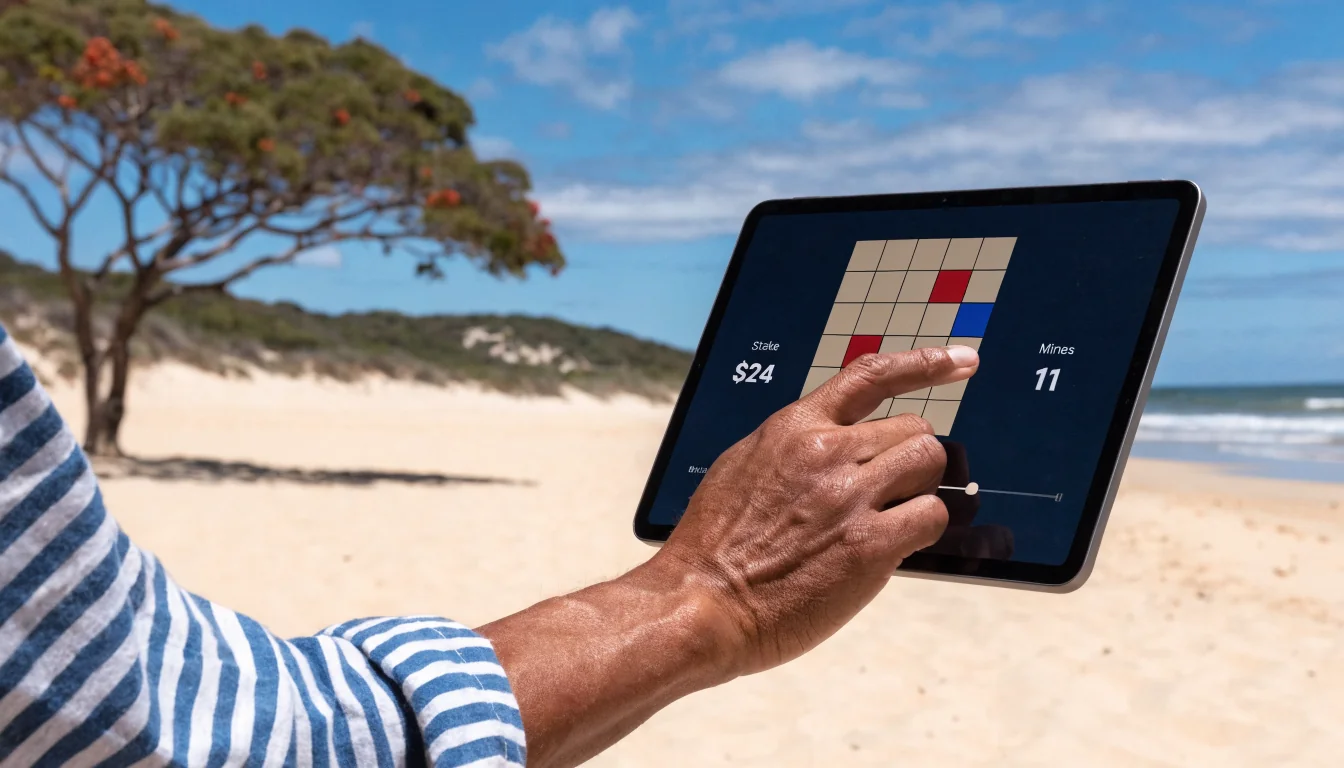
Once you’ve locked in mine count and stake, you start clicking. Each tile you reveal that turns up safe bumps your current multiplier upward, and the game shows you, in real time, what your payout would be if you cashed out right now. That number sits there the whole round, updating tile by tile, daring you to keep going or take it.
If you click a tile that happens to be a mine, the round ends immediately. Every mine on the board is typically revealed to you at that point — a small, slightly cruel courtesy, showing you exactly how close you were or weren’t. Your stake for that round is gone, and you start again with a fresh grid.
There’s also usually an auto-cashout setting, letting you pre-select a multiplier target and have the game bank your winnings automatically once it’s reached, without you needing to click "collect" yourself. I used this more than I want to admit, mostly because I don’t trust myself at 1am to actually press the button instead of going for one more tile.
The mathematics underneath the grid

Because the mine count is something you set yourself, the odds shift every round depending on what you choose — which is different from a pokie, where the house edge is baked into the machine and you never get to touch it. In Mines, the maths works against you in the same fundamental way any casino game does — the house edge is real and it doesn’t go away just because you’re the one clicking — but the shape of your risk on any individual click is something you’re actively deciding.
Think about it this way: with very few mines on a big grid, each click is closer to a coin flip weighted heavily in your favour, safe tile after safe tile, and your multiplier inches up. It feels almost boring. With a lot of mines packed into the same grid, every click is genuinely dangerous, and the multiplier for a successful reveal jumps hard because you’ve dodged something with real odds of catching you. Both setups have the same house edge sitting underneath them. What changes is the variance — how wild the swings feel — not the fundamental lean of the game against the player.
I mention this because I fell for the classic trap of thinking a low mine count made the game "safer" in some meaningful sense. It doesn’t make the game safer. It makes each individual click less likely to end badly, but it also means the payout for surviving is smaller, so you end up clicking more tiles to get anywhere, which is more total exposure to the one bad click that ends it all. There’s no version of the grid where the house isn’t the house.
Why the "just one more tile" feeling is the whole game
The single most honest thing I can say about Mines is that it’s built entirely around a decision point that never goes away. Every tile you clear, you’re handed the exact same question: bank it, or push on. And the multiplier ticking upward on screen makes "push on" feel like the obviously correct answer almost every single time, because you can see, in real numbers, what you’re leaving on the table if you stop now.
This is different from watching reels spin on a pokie, where the outcome’s already locked in and all you’re doing is watching it resolve. Mines makes you complicit in every step. If you hit a mine on tile eleven, you can’t tell yourself the game did it to you — you’re the one who clicked. That ownership is oddly addictive. It also means the sunk-cost feeling hits differently. You’re not regretting a spin. You’re regretting a decision you made three seconds ago, and the fix always looks like it’s one tile away.
I don’t say that to be dramatic about it. I say it because if you’re going to play this game at all, understanding that psychological hook matters more than understanding the exact odds behind any particular mine count. The maths is fixed and unfavourable in the way all casino games are. The bit that actually gets people isn’t the maths. It’s the interface constantly showing you a bigger number and asking if you’re brave enough to go get it.
Grid variations and how studios differ on the format

Not every Mines game looks identical, even though the core loop — pick tiles, avoid mines, cash out — never changes. Some versions run a smaller grid for faster rounds. Some let you adjust grid dimensions as well as mine count, giving you more granular control over risk than the standard fixed-size layout. Some display the potential payout for every remaining tile before you click, essentially showing you the full probability tree in advance; others only show you your current multiplier and make you work out the rest yourself.
There’s also a difference in how "provably fair" mechanics get presented, particularly on crypto-friendly platforms where the game seed and hash can be checked against the result after the round, letting you verify the mine placement wasn’t tampered with after you started clicking. I won’t pretend I fully audit these seeds myself — I don’t have the patience — but knowing the option exists on some platforms and not others is worth knowing before you assume they all work the same way.
What doesn’t change, no matter which version you’re on, is the fundamental shape of the game: hidden mines, a grid of tiles, a rising multiplier, and a cash-out decision you make every single click. If you’ve played one Mines game you can sit down at almost any other and know exactly what’s being asked of you within about ten seconds.
Why this matters specifically for players in Australia
Here’s where I need to be straight with you, because this is the part most sites gloss over or bury in fine print, and it’s the part that actually affects whether you should be reading the rest of this article as entertainment or as something with real consequences.
Under the Interactive Gambling Act — the primary Commonwealth law covering online gambling here, brought in with harm minimisation as its stated purpose — online casino-style games are prohibited. That list explicitly includes slots, poker, blackjack, and roulette, and Mines sits squarely in that same category of random number game, regardless of what label a site slaps on it. I’ll flag something directly rather than pretend it’s settled: some sources cite this prohibition as originating with the Interactive Gambling Act 1997, others point to the 2001 Act as the operative law. The sources disagree on the year, and I’m not going to paper over that by picking one and pretending it’s not in dispute. What both versions agree on is the substance — offering online casino games to Australian residents is against the law.
Legal Risk
Playing Mines on an offshore site is not illegal for you personally, but offering the game to Australian residents is prohibited under the Interactive Gambling Act. Operators can be fined or blocked, and the service may disappear without notice.

The important nuance, and it’s one worth sitting with for a second: this law is aimed at operators, not at individual players. It is not illegal for you, personally, to play Mines at an offshore-licensed site from your lounge room in Brisbane or Perth. What’s illegal is a company setting up shop to offer that game to Australian residents. That distinction is exactly why every Mines game you’ll find being played by Australians online is running on an offshore licence — because there are no domestically licensed real-money online casino operators available to Australian players, full stop. There’s no local licence to point to, because it’s not possible to obtain one to run an online casino domestically in the first place.
This is also why you’ll never see a legitimate Australian-based casino operator advertising Mines as their own product with an Australian gambling licence attached. That licence doesn’t exist here for this category of game. Anyone telling you otherwise, or implying you can "check the local licence" before playing, is asking you to verify something that has no register to check against.
The blocking campaign, and what it actually means for access
Because operators can’t be licensed here, the regulatory response has focused on access rather than licensing. The Australian Communications and Media Authority has had the power to order internet service providers to block illegal offshore gambling sites since November 2019, and it’s used that power steadily since.
The numbers on exactly how many sites have been blocked depend on which report you’re reading and when it was published, and I’d rather flag that plainly than quote one figure as if it’s the current, fixed total. One account puts the blocked figure at 975 illegal gambling and affiliate websites since November 2019, as reported around 2024. A later account — this one according to iclg.com, reporting as of August 2025 — puts the number at 1,296 blocked sites and affiliates since 2019, with roughly 220 services having voluntarily exited the Australian market. Those two figures aren’t really contradicting each other so much as tracking the same ongoing campaign at two different points in time — the number’s grown, which makes sense given it’s a rolling enforcement effort rather than a one-off action. Separately, and this is worth naming as coming from one specific source rather than treating it as an agreed industry figure — according to theiaga.org, more than 100 illegal gambling services, including online casinos, exited the Australian market since ACMA began enforcing tighter rules back in 2017. That’s a different starting point and a different count from the more recent figures above, which is exactly why I’m not blending them into one tidy statistic.
What this means practically, if you’re in Australia and you come across a site offering Mines: the site can be, and often eventually is, added to ACMA’s blocking list, because ACMA can request ISPs block access to any platform offering games not permitted under Australian law — and that explicitly covers online casinos and online slots, which is the bracket Mines falls into whether or not the marketing calls it a "slot." Access to a given site isn’t guaranteed to be stable long-term. A platform you can reach today isn’t necessarily one you’ll be able to reach in six months, and that’s not a hypothetical — it’s the stated, ongoing purpose of the blocking programme.
What this doesn’t mean for you as a player
I want to be careful here, because it’s easy to read all that regulatory detail and either panic or shrug it off entirely, and neither reaction is quite right.
It doesn’t mean you’re committing an offence by playing Mines on an offshore site. The law, as it’s structured, targets the businesses offering the game to Australian residents, not the individual sitting on their couch clicking tiles. That’s a genuinely different legal position from, say, doing something where you personally could be prosecuted.
It also doesn’t mean the space is unregulated or that nobody’s watching. ACMA’s enforcement — the blocking orders, the site takedowns, the fact that operators keep exiting the market under that pressure — is real activity with real consequences for the businesses on the other end of it, even if it doesn’t touch you as a player directly.
And it doesn’t mean every offshore Mines platform is the same as every other one. Some carry licences from other jurisdictions — Malta, the UK, and similar bodies license operators that then serve players in markets like Australia where no local licence framework exists for this category. Those licences aren’t Australian licences and they don’t put the site into any Australian register, because no such register exists here for online casino games. But they’re not nothing either. It’s a genuine difference between an operator that’s licensed somewhere with actual oversight, and one that isn’t licensed anywhere at all.
I’d stop short of telling you to "check the licence" the way you might on a market where local licensing is genuinely how things work — because in Australia, checking for a local casino licence means checking for something that structurally cannot exist. What you can reasonably do is notice whether an operator names a licensing body at all, understand that whatever body it is, it isn’t an Australian one, and factor that into how much trust you’re extending. That’s a smaller, more honest ask than pretending there’s an official local register to consult.
The actual risk profile of a picks game like this
Setting the legal framework aside for a second, I want to talk about why Mines specifically deserves a bit more caution than people give it, purely as a piece of game design.
Pokies have a rhythm to them that’s almost meditative — spin, watch, spin, watch. There’s very little decision fatigue because there’s very little to decide. Mines is the opposite. Every single tile is a fresh choice, and the game is explicitly built to make "one more click" feel rational by showing you a live, growing number the entire time. That design isn’t neutral. It’s optimised, the same way any interactive product is optimised, to keep you engaged, and "engaged" in a game where losing means losing your stake outright is a double-edged thing to be.
I noticed in my own play that Mines sessions felt shorter in wall-clock time than pokie sessions used to, but somehow more intense — more decisions packed into less time, more of that "I was so close" feeling per hour played. That’s not a scientific observation, it’s just what it felt like from the inside, but I think it’s worth naming because nobody selling you the game is going to tell you that part.
The house edge doesn’t disappear because you’re the one making the choices. It’s baked into the probability of the mine placement itself, adjusted for whatever mine count you picked. Every tile you successfully reveal is a tile that survived odds that were, on balance, set up against you continuing to survive them indefinitely. The multiplier climbing is real. The eventual mine, statistically, is also real, and it’s coming for every round you don’t cash out of first.
Where Mines sits relative to other games you might know

If you’ve played blackjack or roulette before moving to Mines, the shift in feel is significant even though the legal category is identical — all of them sit under that same "online casino style game" umbrella that’s prohibited from domestic licensing. Blackjack gives you a decision against a dealer with cards you can partly reason about. Roulette gives you none — you bet, the wheel spins, that’s it. Mines sits somewhere odd in between: no opponent, no cards, but a constant stream of small decisions that feel like they matter more than a roulette spin because you’re the one physically clicking each tile.
For Australian players specifically, none of that changes the legal framing — it’s still a random number game being offered without any domestic licensing pathway, same as the others. But it might explain part of why Mines has become the specific game people search for by name, rather than just lumping it in as "another pokie." It doesn’t feel like a pokie when you’re playing it, even if the regulatory bracket it sits in is identical.
A quick, honest note on what "understanding the game" actually buys you
I’ll finish this section the way I’d finish explaining it to a mate at that same barbecue, if he asked me straight: knowing how Mines works doesn’t make you good at it, because there’s no skill layer sitting on top of random mine placement that you can train your way past. What understanding the mechanics gives you is the ability to see the trap for what it is in real time — to notice that the rising number on screen is doing exactly what it’s designed to do, and to make your cash-out decision as a decision, rather than as a reflex you didn’t notice yourself making.
That’s genuinely most of what there is to "understanding" this game. The grid, the mines, the multiplier, the click — that’s the whole mechanic, dressed up differently by different studios but never fundamentally changed. Everything else, the promos and sign-up offers and the rules around how those get regulated here, belongs to a different conversation entirely.
Mines Slots Bonuses, Promo Codes and Australian Regulatory Limits
Here’s where it gets messy. Type "mines casino no deposit bonus" into a search bar and you get a wall of sites promising a promo code, a bonus, a login page, a fresh account with money already sitting in it. I’ve clicked through a lot of those pages. Most of them are trying to sell you something without ever telling you who’s actually letting you play.
Let’s separate the two things that get blurred together constantly: what a bonus code actually does, and what Australian law actually allows.
What promo codes and no-deposit offers actually are

A promo code or a "no deposit bonus" is a marketing tool. It’s a string of letters an operator hands out — through an affiliate site, an email, a banner — that unlocks some kind of credit or spin allowance without you putting your own money in first. That’s it. It’s not a certification, it’s not a licence, it’s not proof the site is legitimate. It’s a hook.
I’ve seen "exclusive" bonus codes for Mines slots that were just the generic sign-up promo copy-pasted across a dozen affiliate blogs, none of which disclosed how they’re paid for sending you there. None of that makes the underlying game any different from what I described earlier — same grid, same random mine placement, same cash-out decision. The bonus sits on top of it. It doesn’t change the mechanics, and it shouldn’t change your judgment about the mechanics either.
The regulatory reality behind all of it
Here’s the part most of those bonus-code pages skip entirely: online casino-style games, including slots, are prohibited under the Interactive Gambling Act 2001. That’s the federal law. Mines, as a slot-style game, falls into that basket along with poker, blackjack and roulette when offered online to someone in Australia.
What that means in practice is not that you’ll get arrested for playing. The law targets the businesses offering the games, not the individual punter clicking tiles at 11pm. Playing at an offshore-licensed site isn’t illegal for you personally. But it does mean there is no such thing as an Australian-licensed Mines slot, no local regulator who signed off on the RTP, and no local body you can complain to if a promo code turns out to have conditions nobody disclosed upfront.
That last point matters more than people think, because Australia’s gambling regulation isn’t one tidy system — it’s several. There’s no single overarching statute or single authority covering all of it. Instead you get a patchwork:
- ACMA (Australian Communications and Media Authority) enforces the Interactive Gambling Act 2001 at the federal level.
- The Northern Territory Racing Commission (NTRC) licenses most of the national online bookmakers, largely because of the lower tax rate up there — which has made it the de-facto regulator for online wagering, even though its formal remit doesn’t extend to overseas casino sites.
- Every state and territory runs its own gambling regulator on top of that. Victoria has the VGCCC, NSW has Liquor & Gaming NSW, and so on.
- Land-based casinos answer to their own state regulators and law enforcement — a completely separate lane from anything ACMA does online.
The VGCCC does monitor wagering providers across state lines for compliance with the National Consumer Protection Framework, which sounds like broad coverage. It isn’t, once you’re talking about an offshore Mines slot. State and territory regulators, VGCCC included, have limited power over operators sitting outside Australia. They can flag concerns, they can warn people. They can’t licence the site, audit its RTP, or make it honour a bonus code the way a local regulator could for, say, a licensed sports betting app.
Why that gap matters when you’re chasing a bonus
I used to think "regulated" was a yes/no label. It’s not, not here. A site can be regulated somewhere — Malta, Curaçao, wherever — and still sit entirely outside anything an Australian authority can enforce. When a bonus code page tells you to "play at a licensed casino," ask licensed by whom, and whether that licence has any jurisdiction over a dispute you might have. Often the honest answer is: no local body does, and none is going to appear.
That’s not a reason to panic every time you see a promo code. It’s a reason to read what the code actually unlocks before you chase it. A no-deposit offer on a Mines slot is worth exactly what its terms say it’s worth — nothing more, regardless of how the landing page words it. There’s no Australian regulator standing behind those terms the way there is behind a wagering account, and no register you can check to confirm the operator is who it claims to be.
What actually differs between offers
Where I have seen genuine variation is in how upfront a site is before you commit anything. Some display the conditions attached to a bonus in plain view before you claim it. Others bury them behind a "terms apply" link that goes nowhere useful. That difference is worth noticing, because it’s often the only real signal you get about how the rest of your experience with that operator is going to go.
What doesn’t differ: the legal status. Every offshore Mines slot marketed to an Australian player sits in the same position under the Interactive Gambling Act 2001 — outside the federal framework, outside state licensing, running on a licence issued somewhere else entirely. A flashy bonus code doesn’t move that needle. It’s a discount on a game whose regulatory address is, from Canberra’s point of view, nowhere in particular.
Is Mines a slot machine?
Mechanically it is not a slot. A pokie’s outcome is fixed the instant you press spin, whereas in Mines the positions are set randomly but you actively choose the mine count, the grid size, and exactly when to cash out — so your decisions matter on every single tile.
How do the odds in the Mines casino game work?
Fewer mines mean each click is more likely to be safe but your multiplier climbs slowly. More mines make the multiplier jump faster per safe tile, but the risk of hitting one early is far higher. Both setups carry the same underlying house edge — only the variance changes.
Are online casinos legal for Australian players?
It is not illegal for you to play at offshore-licensed online casinos, as the Interactive Gambling Act 2001 targets operators rather than players. However, there are no domestically licensed real-money online casinos available, and ACMA actively blocks illegal offshore sites.
How does the Mines casino game actually play?
You set your stake and choose how many mines to hide in the grid. Each safe tile you reveal bumps your multiplier upward, which is displayed in real time — you can cash out at any moment, but clicking a mine ends the round immediately and you lose your stake.
What is the minimum legal gambling age in Australia?
Gambling regulation in Australia occurs at the state and territory level rather than federally, so there is no single national statute — the legal age is set by your local jurisdiction.
Prepared by the Casino Payments Guide editorial staff.